

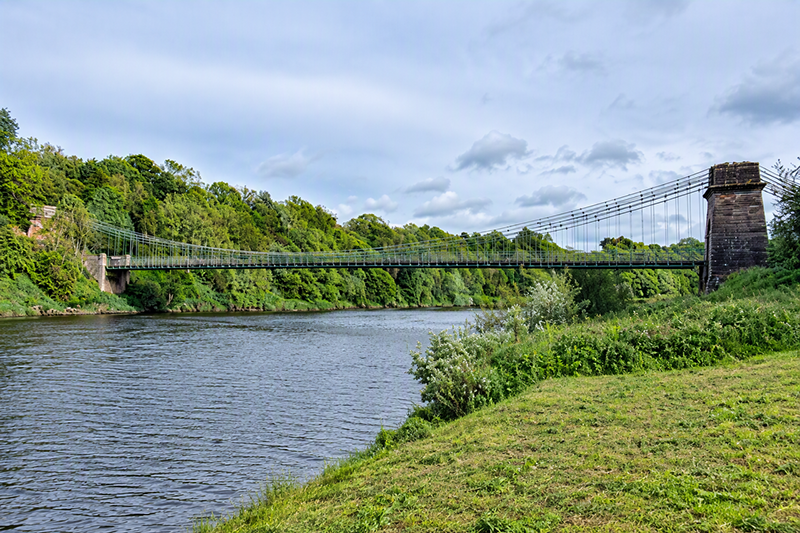
As more existing infrastructure requires intervention, engineers face the challenge of deciding what can be retained, what can be repaired or strengthened, and what ultimately needs replacing. Here, Robert Paterson, operations director at engineering and infrastructure technology specialist DYWIDAG, outlines how engineers approach the task, and what gives asset owners confidence in the result.
DETERIORATION in one part of a structure does not automatically justify wholesale replacement. Where assessment supports it, targeted intervention can retain serviceable elements while addressing the areas that need attention. The challenge is establishing what is necessary and delivering it safely within an existing asset. That requires a clear understanding of the structure before a solution is selected.
The strengthening of Union Chain Bridge’s anchorages illustrates how specialist systems and site expertise can support this approach within a wider restoration programme.
Understanding what can be retained
Construction and maintenance records may be missing or incomplete. Earlier repairs may have altered the structure, while elements hidden in masonry, concrete or ground may only be fully understood once work starts. Corrosion and joint movement can also change how loads are transferred. Condition assessment helps distinguish local deterioration from defects requiring more extensive intervention.
Non-destructive testing (NDT) can provide further evidence about the condition of the structure, helping engineers determine where targeted repair or strengthening may be appropriate and where further investigation is required. Uncertainty can remain. Inspection during the works may expose undocumented repairs, voids or components that differ from expectations. These findings can affect connection positions, anchor lengths or acceptance criteria.
The design must allow a controlled response to what is exposed. Any changes remain the responsibility of the designer and should be supported by appropriate verification.
Choosing an intervention that can be delivered
Once the condition and required performance are understood, the team can assess suitable repair or strengthening methods. DYWIDAG’s capabilities include concrete repair, external post-tensioning, threadbar reinforcement and carbon fibre strengthening. The choice must reflect the defect, the existing structure and the constraints on delivery. Where strengthening introduces new connections, these must provide the required capacity while remaining compatible with existing materials, geometry and load paths. On heritage structures, they must also respect the original fabric.
Installation is part of that decision. Restricted access, limited equipment space and tightly controlled highway or rail possessions can influence the solution. Where operations continue, the design must accommodate them while maintaining structural stability throughout the works.
Early engagement between DYWIDAG, the designer, principal contractor and asset owner brings system requirements and installation considerations into the discussion before work begins. This helps the team assess whether the proposed intervention is practical to install as well as structurally appropriate.
Case study: Applying the approach at Union Chain Bridge
Opened in 1820, Union Chain Bridge spans the River Tweed between Northumberland and Berwickshire. Its restoration involved strengthening the original anchorages, with challenging ground conditions, restricted access and historic masonry to protect. DYWIDAG supplied specialist post-tensioning components for the new anchorage arrangement, including 32 unbonded prestressing tie bars of 32mm diameter. 16 bars were installed at each side of the bridge, each stressed and locked off at 534 kN.
The contribution extended to technical support and supervision, with a specialist team carrying out the jacking and locking-off of the bars. This brought component supply and site expertise together to achieve the specified lock-off loads within the new arrangement.
The example shows why the strengthening system and its installation must be considered together. The components had to work with the existing structure, while the site operations had to meet the requirements of the design.
Protecting and verifying the intervention
Achieving the required capacity is only part of extending service life. Durability must also be designed around exposure, intended working life and access for future inspection and maintenance. Depending on the application, protection may involve coatings, sealed or sheathed systems, grout or cathodic protection for steel reinforcement.
For bar and tendon systems, durability depends on the complete assembly, including anchorages, couplers, seals and protective materials. Detailing and installation matter: an incompletely filled protection zone can undermine a well-specified system. The asset owner also needs evidence that the work meets the designer’s requirements. Relevant standards and engineering judgement should inform verification, supported by material traceability and documented installation procedures.
For stressed systems, records should include calibrated equipment, applied loads, movements and lock-off values, together with inspection of completed protection details. These records provide a reference for future inspection and maintenance. Where appropriate, monitoring can then show how the repaired or strengthened asset performs over time and inform subsequent decisions.
Extending service life therefore depends on more than selecting a strengthening product. It requires an intervention justified by the asset’s condition, designed for its constraints and verified in practice. That gives owners a defensible basis for retaining useful infrastructure and planning its continued care.