
Jörgen Gudnason, who represents Scandinavian Floor Contractors Ltd, Scotland, explains why older Scottish timber floors should be restored rather than replaced
AFTER nearly 30 years working with wooden floors across the United Kingdom and beyond, I have learned that the most beautiful floor is not always a new one. Often, it is an old floor that someone has had the patience and skill to restore.
My career has taken me from private homes to major commercial and cultural buildings, including specialist timber restoration and French polishing work at the British Museum and National Portrait Gallery. Working in such prestigious surroundings taught me the importance of respecting traditional craftsmanship. French polishing, in particular, requires patience, precision and an understanding of how wood responds to different finishes. A historic surface should never lose its character simply because someone wants it to look new.
That philosophy is especially relevant in Scotland, where I have discovered some extraordinary pine flooring.
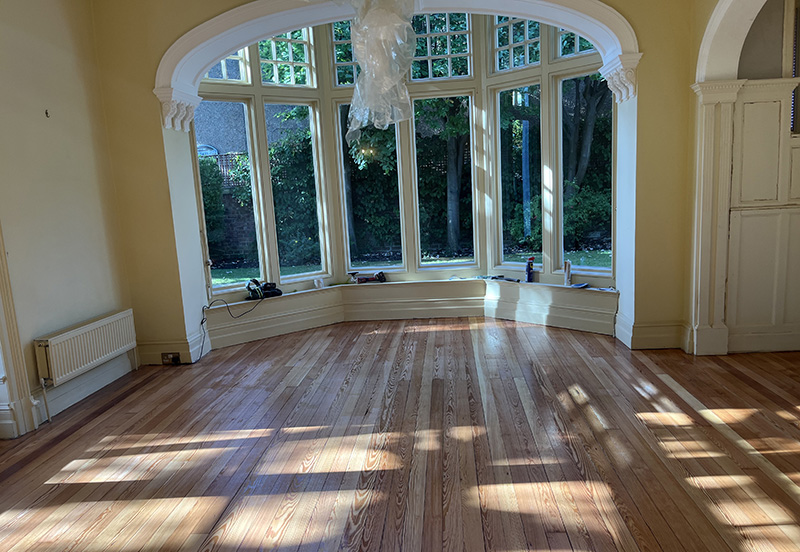
Scottish pine is simply stunning. Although technically classified as a softwood, older, well-seasoned Scottish pine can be remarkably dense, durable and resilient. Its beautiful grain, natural knots and warm character make it a pleasure to work with. There is something genuinely satisfying about sanding an old Scottish pine floor and watching decades of wear disappear, revealing the magnificent timber underneath.
One of the qualities I admire most is how receptive pine can be to different colours and finishes. With the right preparation, it responds beautifully to oils, stains and natural varnishes. Oil can enhance its depth and warmth, while carefully selected stains allow us to introduce entirely different shades without concealing the natural grain.
I particularly enjoy creating lighter, Scandinavian-inspired finishes. Bona products have become an important part of our finishing work, especially when creating bright, contemporary floors. Bona White, for example, can produce a beautiful whitewashed effect that complements the natural character of Scottish pine. With suitable sealers and protective coatings, these finishes can also be practical to maintain.
Over the years, I have developed experience with specialist acid-based treatments that can give wooden floors a distinctive, weathered appearance. These techniques can create beautiful driftwood-inspired tones, reminiscent of timber naturally aged by the sea. They require careful testing, correct preparation and an understanding of the wood’s reaction to the treatment. When applied appropriately, the result can be truly exceptional.
However, achieving a beautiful finish starts long before applying oil or varnish. We carefully inspect the condition of every floor, checking the boards, old repairs, moisture and any potential structural issues. Some floors require individual boards to be repaired or replaced, while others simply need professional sanding and refinishing.
We also specialise in dust-controlled wooden floor sanding, using professional extraction equipment to minimise airborne dust. Careful sweeping, vacuuming and surface preparation are essential parts of our process. Modern sanding technology allows us to restore floors with considerably less mess and disruption than traditional methods.
Another great advantage of restoring timber flooring is how straightforward maintenance can be when the correct finishing system is selected. Regular cleaning, protection from excessive moisture and appropriate maintenance products can help preserve the surface for many years. Depending on the finish, future maintenance may also be possible without completely sanding the floor again.
There is also an important environmental consideration. Why remove beautiful, usable timber simply to replace it with something new? Restoring existing floors can reduce waste, conserve valuable materials and preserve the original character of Scotland’s historic buildings.
I believe Scotland possesses some of the most beautiful traditional timber floors in Britain. We should celebrate them rather than automatically replace them. After three decades in this industry, my passion remains unchanged: taking an old, forgotten wooden floor and revealing the beauty that has been there all along.
Sometimes the finest floor you can install is the one that is already beneath your feet.