


Matthew Bonner, chief operating officer of EGG Lighting, discusses the challenges of a floodlight replacement project at Scotstoun Stadium for Glasgow Life
ON most jobs you build a programme and work through it. On some jobs you find out each morning which part of it you are allowed to do.
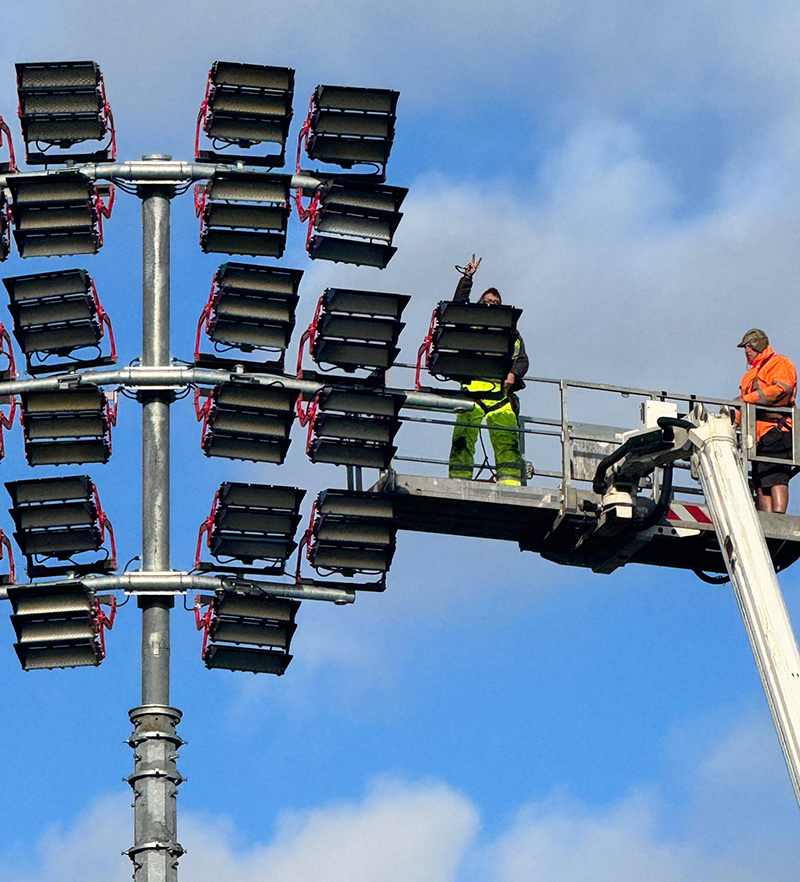
Scotstoun Stadium in Glasgow needed 96 floodlight heads replaced across four masts at 25 metres, to a date that could not move. Venue operator Glasgow Life appointed EGG Lighting as electrical contractor for the lighting. The installation being replaced had as-installed drawings dating to 2010.
The electrical scope was easy to write down: safe isolation of each column, removal of the 96 existing heads, installation of 96 Abacus Challenger luminaires — 1500W, 5700K, DMX-driven — then testing, certification and aiming. The existing switching arrangement was retained, and so were the four legacy columns; Abacus, as manufacturer, replaced the bracketry and carried out remedial works with their engineers on site alongside our team for much of the programme.
What made it difficult had nothing to do with lighting.
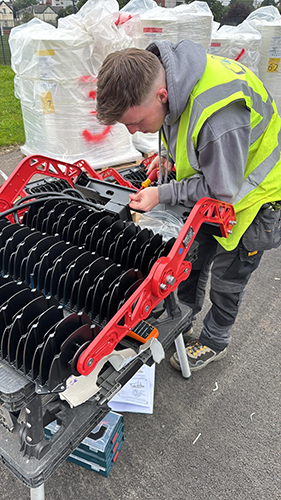
In the summer of 2025, Scotstoun was not a lighting site. It was a track site. The old athletics track had been stripped out, and the sub-base prepared. Asphalt was going down ahead of a MONDO track installation, and DYNAMIK Sport was running the site as principal contractor. We were a guest on somebody else’s programme — inducted onto site, signing in and out of their logbook, agreeing access every morning.
Which columns we could lower was decided each morning, not in advance, depending on where the track-laying team had reached. We negotiated permission to lower two at a time where it would speed things up, but only with the site manager’s agreement on the day. And a lowered 25-metre column lies right across the track, so where new surface was already down, 18mm plywood protection went down first. The telehandler needed for the bracket work couldn’t go on a wet track — in Glasgow, in August — and couldn’t be left on it overnight under any circumstances.
None of that was negotiable, and none of it was going to move the date.
The answer was to build a sequence that could be reordered rather than queued. If the track team’s progress ruled out a column that morning, the crew moved to another rather than standing down. That sounds obvious written down. In practice it means every column has to be independently ready to start — materials staged, isolation planned, certification paperwork open — rather than the job progressing along a single critical path. It is more preparation for the same amount of work, and it is the difference between a crew working and a crew waiting.
Two specification decisions came out of it that are worth borrowing.
The cabling was specified on site rather than at order stage. The runs between luminaire and driver could only be settled once the masts were surveyed, and lengths and terminations simply aren’t knowable when the order goes in. We specified 8-core H07RN-F 8×1.0mm². It is a small thing that becomes a large thing if you find it in week three with a track going down around you — and on a job with no float, finding it early was worth more than the specification itself.
The drivers sit at the base of each column, not at the head. The columns had a weight limit, which made low-level mounting the sound structural choice. But the more useful consequence is maintenance: a driver failure can be attended from ground level, without lowering a mast or booking a lift. Over a service life, that is the difference between a call-out and an operation. The drivers are DMX compatible, so the installation is not locked to one luminaire either.
On procedure, nothing clever. Every column was isolated before anyone touched it — point of isolation identified, locked off, labelled, key retained by the operative doing the work, and proved dead across every combination of line, neutral and earth, with the test equipment itself proved before and after. No live working was permitted on the project under any circumstances, and the risk assessment said so in terms. Every electrician on site worked to 18th Edition, with an SSSTS operative present throughout. Every day closed the same way: circuits made safe, plant stored clear of the track works, a handover to the site manager setting out the next day’s working area.
Testing followed the full sequence — continuity, insulation resistance, polarity, earth fault loop impedance, prospective fault current, RCD and phase sequence — with Minor Works Certificates and lux readings required at handover.
On verification: the design document specified 1,500 lux across the field of play with a tolerance of 10%. The team walked the arena at night, taking readings against the design figures. Every reading fell inside the tolerance. It took an evening, and it is the difference between believing a specification and knowing it.
Phase 1 went on site on 28 July 2025 and handed over that September, in time for Glasgow Warriors’ 2025/26 season and for the athletics clubs who use the track year-round. Phase 2 followed in early 2026. The stadium stayed open throughout — no season lost, no fixtures moved. The lighting performed throughout the Games.
The transferable part isn’t the lighting. It’s that on a site you don’t control, the programme is not a plan you execute. It’s a set of options you keep ready.