

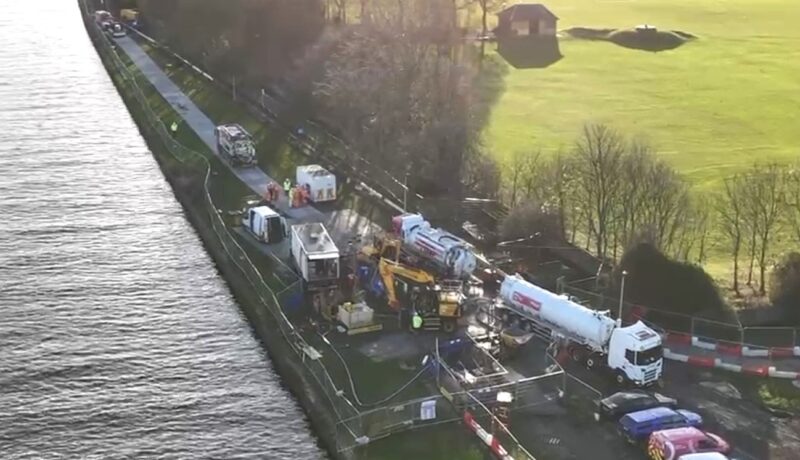
DRAINAGE engineers from Lanes Group have helped resolve a persistent local flooding problem by lining a large diameter sewer located along the bank of a river.
Installing the ultraviolet light-cured liner in the sewer next to the River Esk in Musselburgh prevented infiltration of tidal water that contributed to intermittent flooding, especially during heavy rainfall.
Principal contractor AG Wilson, working for Scottish Water, commissioned Lanes Group to line the pipe to end the disruption the flooding was causing to local communities.
AG Wilson project manager Dean McAleese said, “We were pleased to work with Lanes Group on this challenging project at Goose Green in Musselburgh. The team demonstrated a high level of expertise and responsiveness in addressing a complex issue influenced by tidal conditions and heavy rainfall.
“The solution delivered has successfully eliminated flooding and provided a long-term improvement to the resilience of the network, all while minimising disruption to the local community.”
Lanes Group’s Scottish Water account manager, Chris Fairbairn, added, “UV CIPP lining was an ideal solution, not least because the sewer is in a constrained space on a river bank. Using our no-dig technology to restore the resilience of the local sewer network avoided the need for full excavation and pipe replacement which would have been much more expensive and disruptive.
“The project demonstrates that CIPP lining can be used to rehabilitate sewers that are ageing or compromised by multiple defects, saving capital funds to be spent on other urgent asset improvements.”
Intervention was needed because CCTV surveys showed water from the River Esk was infiltrating the concrete pipe during high tides, reducing its capacity and increasing the risk of local flooding. The solution devised by Lanes Group’s Glasgow depot, supported by the company’s lining division, was to install a 165-metre-long liner to restore the pipe’s integrity.
Ultraviolet light cured in place pipe (CIPP) lining tech was selected because it was the ‘quickest, most sustainable and least disruptive’method to rehabilitate the pipe.
In a project that took just over a month to complete, Lanes Group first carried out CCTV surveys to assess the precise condition of the pipe and the type and extent of defects. This helped determine the dimensions of the liner to be installed.
A drone survey was also carried out to provide a complete overview of site constraints, so the work area could be properly protected and made safe for the public and operational teams.
An over-pumping system was put in place to control water flows in the pipe to allow the liner to be installed, protect Lanes Group teams, and prevent further flooding.
The liner was installed between two access chambers, with limited excavation carried out to create the extra working space needed to guide the liner into the pipe. It was pulled through the pipe with a winch, then inflated with compressed air.
A ‘light train’ fitted with powerful UV bulbs was then sent through the liner to cure resin embedded in it.
This, Lanes explained, created a ‘tough and smooth’ new pipe-within-a-pipe, preventing water ingress and strengthening the sewer, giving it a design life of at least 50 years.
Lanes Group applies a range of CIPP lining solutions to resolve different time-bound and technically challenging infrastructure and construction projects across Scotland, said Chris Fairbairn.
“The increasing amount of construction infill in urban areas is placing greater demand on our lining services to strengthen culverts and sewers for both renovation and new-build projects,” he added. “Where wastewater assets are already in place, pipe lining is a vital solution to allow projects to be completed on time, and on budget, or where pipe replacement is just not feasible.”