

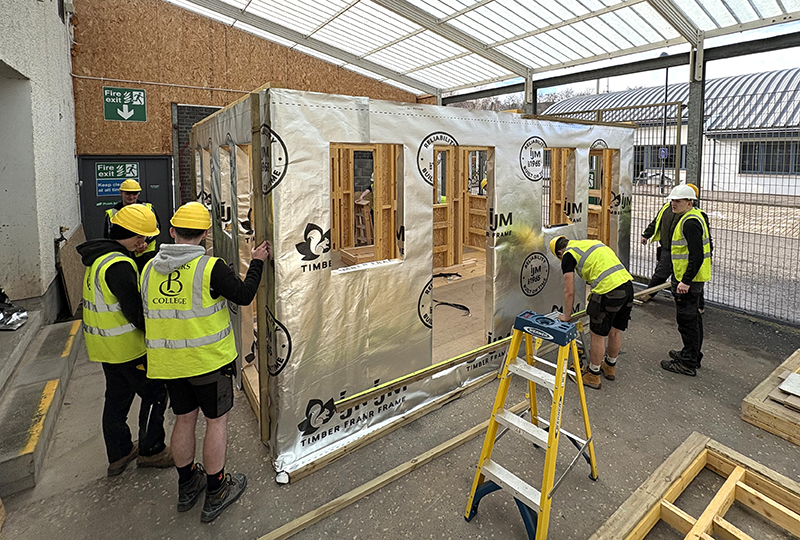
BORDERS College is nearing the submission of a final business case to secure Borderlands Deal funding for the build of a Housing and Net Zero Accelerator Hub at its Galashiels campus, Project Scotland has been told.
The bespoke, modular facility will act as an ‘exemplar’ of the sustainable building techniques taught inside.
The proposed facility will be built using mass timber, glulam beam, and cross laminated timber infill panels. It will feature sawtooth north-facing roof lights, internal classroom pods, and open warehouse spaces designed for practical training.
“We want to practice what we preach,” David Lowe, Borders College interim vice principal, explained. “There’s no point doing this training and we’re putting up a concrete building. We wanted it to be a modular building. In years to come, it also allows us to expand if we wanted to do that; it would just be a case of extending the foundations and adding another module onto the end of it.”
The learning institution is already operating at capacity across its construction-related courses and existing green offerings, which range from heat pump installation to sustainable construction courses. Not only will the new facility allow for demand to be met, but also the introduction of new and timely courses covering retrofit and insulation.

With one third of all homes in the Scottish Borders built before 1945, there is a pressing need for insulation and retrofit specialists in the region. Borders College is intent on ensuring the supply chain has access to the skills required to deliver the anticipated plethora of work.
“I think it’s critical,” David replied, when asked of the importance of ensuring those in rural areas have access to such training. “It’s not just about training new people coming into the industry; it’s also about upskilling and reskilling people who are already in the industry – but maybe want a change of direction. It’s giving these people the skills they need and what employers are looking for.”
Rural areas such as those found in the Borders face particular challenges in terms of retaining young talent, with many leaving to study elsewhere in the country and putting down roots far from home. Scottish Government findings last year revealed that qualified professionals typically only return to rural areas once aged between 30 and 45, as they look to start a family.
“We need to upskill the talent we’ve got and keep them here, so we need to be (providing) well-paid jobs that can do that,” David continued. “This will lead to high-skilled jobs in the region, and the ultimate aim is to keep the talent here.”
A key part in attracting local talent is engaging with youngsters. To that end, the college is committed to collaborating with local schools. David originates from a construction background, having been a bricklayer before becoming a supply lecturer 23 years ago and working his way up, so he appreciates the value of educating people from a young age on the potential career opportunities.
Currently, the college runs the construction craft and technician (foundation apprenticeship) course with pupils from local schools. Another local business – IndiNature – supplies the materials for pupils to make up an insulation panel for timber frame, with the exercise focusing on how to ensure it is properly sealed and taped.
The proposed Housing and Net Zero Accelerator Hub would enable the college to ramp up its work with schools.
“The other flipside about the facility is we’ll be able to bring the teaching staff in as well, to ensure they understand the pathway into college and what the pathway out of college is, and they can then talk to pupils about that pathway,” David added.
The plans have received support from existing partners such as local housing associations, IndiNature, Bosch, Mitsubishi, and heating systems manufacturer Vaillant – with the latter committing a constant stream of its latest equipment to ensure learners are competent on the newest innovations in the sector.
David revealed that all the signs are positive, as the college nears submission of the final business case.
If all goes to plan, it is hoped that the first students will enter the Housing and Net Zero Accelerator Hub in the 2029/30 academic year – with it potentially opening to local employers in January 2029 for short course delivery.