

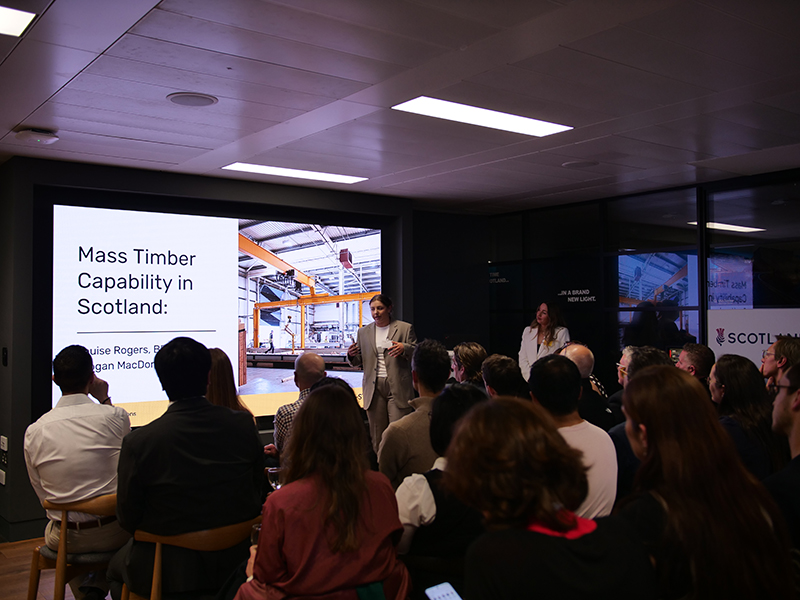
BUILT Environment – Smarter Transformation (BE-ST) has delivered a three-day programme of activities during Futurebuild and UK Construction Week 2026 in London.
Across the exhibition, Scotland’s innovation centre for construction and the built environment contributed to ten events including workshops, programme launches, roundtables, site visits and industry networking.
For the duration of Futurebuild, the BE-ST team hosted a Timber in Construction stand where they showcased a new training rig developed as part of the CITB-funded Timber in Construction Skills project, led by Donaldson Timber Systems in collaboration with BE-ST, Napier, NMITE, STA and TDUK. The project is helping to create the skills, confidence and capability needed to deliver the next generation of homes and buildings from structural timber.
Designed and built by the BE-ST team at its Innovation Campus in Scotland and transported to London for the conference, the rig demonstrates the full assembly and disassembly of a range of timber systems including timber frame, Cross Laminated Timber (CLT), Glued Laminated Timber (glulam) and Nail Laminated Timber (NLT). This assembly and disassembly system forms the basis of new training courses aimed at upskilling site operatives to install offsite manufactured timber systems.
BE-ST also showcased another industry-led skills project – Low Carbon Passport. This course offers a fully-funded online and practical certification where participants learn to bridge the gap between theory and hands-on skills. The programme is backed by partners including Kier, Morrison Construction, Robertson, Passivhaus Trust, and Balfour Beatty and funded by the CITB Industry Impact Fund.
On the opening day of Futurebuild, BE-ST delivered a workshop with the University of Edinburgh focused on the development of a Mass Timber Fire Safety Roadmap. The session brought together stakeholders from across the sector to review research, create consensus around knowledge gaps and agree priorities for further work. The aim was to further enhance a ‘consistent and evidence-based approach’ to fire safety in mass timber buildings through a roadmap funded by Built by Nature.
Speakers included Louise Rogers and Sam Hart from BE-ST’s housing and manufacturing team, alongside Angus Law and Zak Campbell-Lochrie from the University of Edinburgh.
While in London, BE-ST also hosted a networking reception at Scotland House. The event brought together industry representatives, policymakers and delivery partners to discuss current challenges in the built environment, including housing delivery, retrofit and low carbon construction. Carbon Futures were invited to announce the opening of a London office to work and collaborate more closely with organisations across the capital and beyond.
Stephen Good, CEO at BE-ST, said, “Our involvement in Futurebuild and UK Construction Week this year has been all about showcasing the power of connections across the UK. We’ve taken advantage of this platform which brings audiences from across the UK together to demonstrate what BE-ST can do for organisations outside of Scotland, bringing our connections, expertise and resources to create opportunities that reach across borders and enable businesses to drive forward their missions to deliver a low carbon built environment.”
Alex Goodfellow, CEO at Donaldson Offsite, added, “Structural timber has a critical role to play in supporting the UK to overcome the housing crisis and build more sustainable, low carbon homes. I believe that the use of structural timber is the only way we can achieve the volume of homes needed to the high quality and performance standards expected.
“However, the industry’s ability to meet that demand depends on our ability to attract new people to construction and develop the right skills, knowledge and confidence to build using structural timber. The Timber in Construction Roadmap of which this CITB funded project derived, plays an important part in supporting change and growing the use of timber in construction.
“This project plays a critical role by developing robust, accredited training pathways that support new entrants, apprentices and existing construction workers to improve understanding and capability of structural timber systems and best practice. We want to attract more people into the sector, support long-term industry growth and ensure the UK has the skilled workforce needed to deliver the next generation of homes and we’re pleased to lead this project, to deliver those goals.”