

THE use of drones has allowed dynamic line rating sensors to be fitted onto a live transmission conductor in Aberdeenshire without taking the line out of service, in what SSEN Transmission has said is a UK first.
The innovative installation at Kintore Substation involved specialist DLR sensors being carried by drone to an overhead transmission conductor and remotely attached while the circuit remains energised.
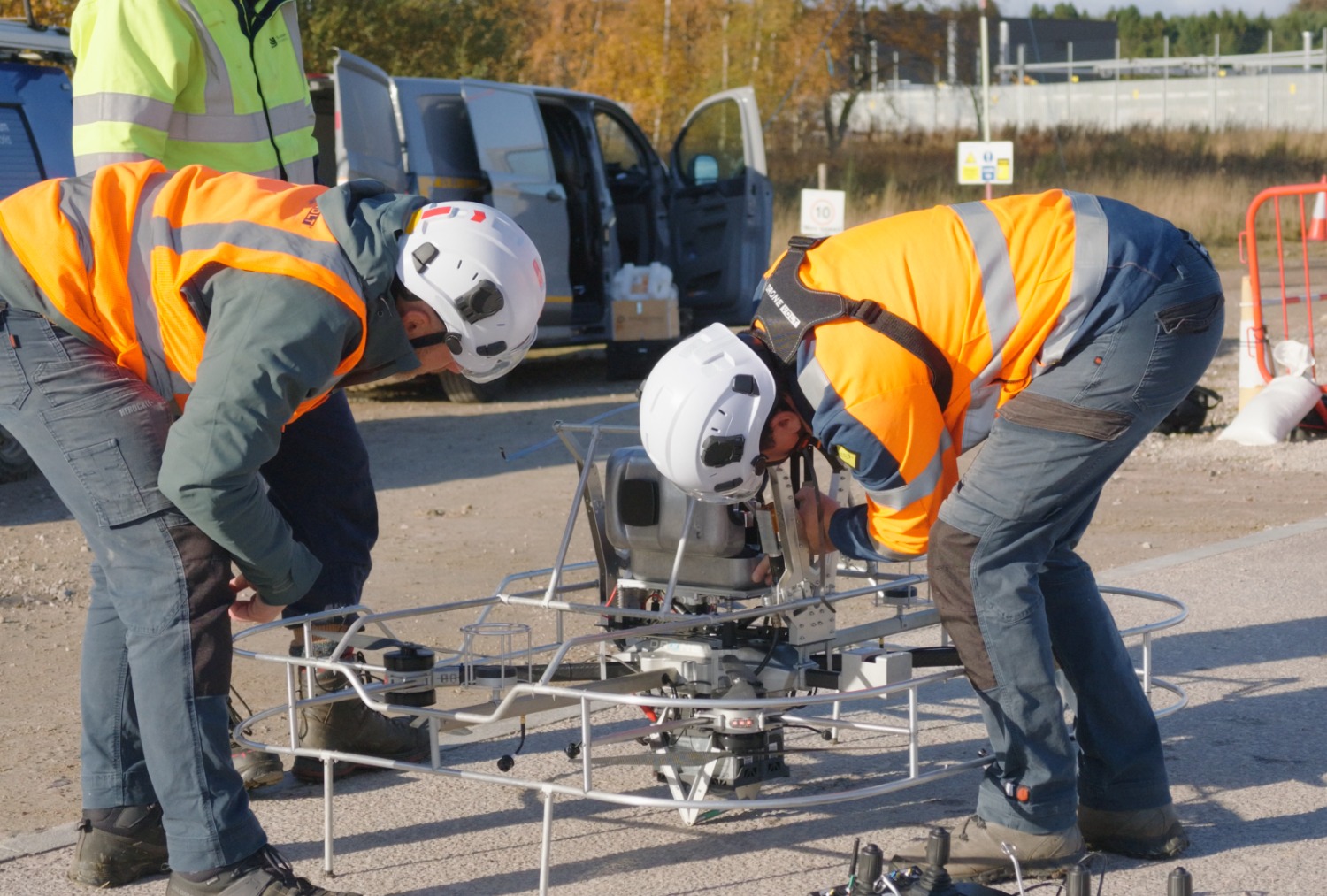
Rather than requiring an outage and conventional physical access to the line, the sensor was mounted on the drone, flown to the conductor, and remotely clamped into position before the drone returns to the ground.
SSEN said that the approach represents the first successful drone installation of DLR technology onto a live transmission conductor in the UK. Around 32 sensors are planned across two circuits at Kintore, with approximately 16 on each.
DLR allows transmission operators to make better use of existing overhead lines by providing a more accurate picture of how much electricity they can safely carry at any given time, SSE explained.
Traditional line ratings use predetermined seasonal limits based on conservative weather assumptions. DLR instead uses real-time environmental conditions – including temperature and wind, to calculate how much electricity a line can safely carry.
When conditions allow, this enables more electricity to flow through the existing network, helping move more renewable generation and reduce the need to constrain generators because of network limitations. In turn, this reduces constraint costs in the system for the benefit of electricity consumers.
In 2025/26, the business delivered nearly £300 million in savings for consumers through interventions which reduced network constraint costs. Network upgrades will ultimately deliver the greatest increase in capacity, but DLR can provide an additional boost by helping ensure existing infrastructure is used as efficiently as possible.
In September, SSEN Transmission announced that DLR had gone live across more than 300km of overhead transmission lines between Beauly and Dounreay, the first DLR-enabled circuit in its north of Scotland transmission area.
At the time, the company confirmed it was working towards live-line drone installation of DLR sensors as the technology was introduced at other suitable locations on its network.
Niall McDonald, SSEN Transmission project director, said, “This is an exciting step forward in how we use innovation to get more from the electricity network, reducing constraint costs for the benefit of consumers.
“Using a drone to install these sensors while the transmission line remains live means we can deploy Dynamic Line Rating technology without taking that circuit out of service for the installation.
“This approach has the potential to make it easier and more flexible to deploy DLR across our network, helping us make better use of existing capacity and move more renewable electricity through the system.
“Following the successful introduction of DLR north of Beauly, achieving a UK first at Kintore demonstrates how we’re continuing to innovate as we build the electricity network needed for the future.”
Martin Queen, Chief Engineer for Ofgem, the energy regulator – who was present at the installation – added, “A live line installation is exceptionally important because it allows us to avoid having system outages, which in a highly constrained system are becoming increasingly difficult to take. So by moving to a live line system of operation and installation, we should be able to get these systems installed quicker and the consumer should be able to see the benefits and reduced costs in a much shorter timescale.”