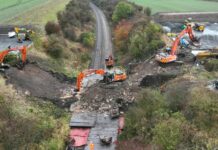


THE collapse of the 19th century Spey Viaduct in Garmouth was likely triggered by a failure within the crossing’s substructure, a new investigation has found.
Scour was initially suspected to be the cause of the collapse in December 2025, but a recent in-depth engineering investigation found scour, metal fatigue, or corrosion of the substructure to be unlikely causes.

Instead, the work identified that the collapse was most likely linked to a failure within the pier support, foundation, or column support system. Further investigations will take place once the collapsed sections have been removed from the river by Devon-based TMS Ltd.
The 950ft-long Spey Viaduct was originally built to carry a single-track railway, featuring a 350ft-long wrought-iron lattice bow girder span over the main channel and three parallel sided wrought-iron lattice girder approach spans of 100ft at either end.
The lattice members of the main arch, 41ft deep at mid-span, rise from open box girders at each side of the deck. Cast-iron caissons filled with concrete form the piers of the viaduct. These were sunk to bedrock at depths of 25-35ft except for the piers at the west end of the central span where it was necessary to sink them to a depth of 75ft.

A recent economic appraisal found that the viaduct provided ‘significant’ value to the local area. Out of 695 people who responded to a community survey, 94% said the viaduct is important to their household, business, or organisation.
Meanwhile 60% said its reinstatement is ‘essential’ for the area to thrive. The report also found that 83% of respondents have reduced their walking or cycling since the closure and 64% reported a negative impact on their wellbeing or sense of community connection.
The appraisal estimates the annual economic, health, and travel benefits of reinstating the viaduct could be worth between £114,000 and £296,000 – although the cost of repair or replacement is not yet known and further work is needed to develop a full business case.
Chair of Moray Council’s economic development and infrastructure services committee, councillor Marc Macrae, said, “These reports provide important information as we continue to assess the future of Garmouth Viaduct. While further investigation work is needed to fully understand the cause of the collapse, the engineering report gives us a clearer picture of what may have happened.
“The economic appraisal also demonstrates just how important the viaduct is to local residents, visitors and businesses. It highlights the impact the closure has had on people’s wellbeing, active travel opportunities and connections within the community.
“We remain committed to gathering the evidence needed to inform future decisions and will continue to keep the community updated as this, and other work, progresses.”