

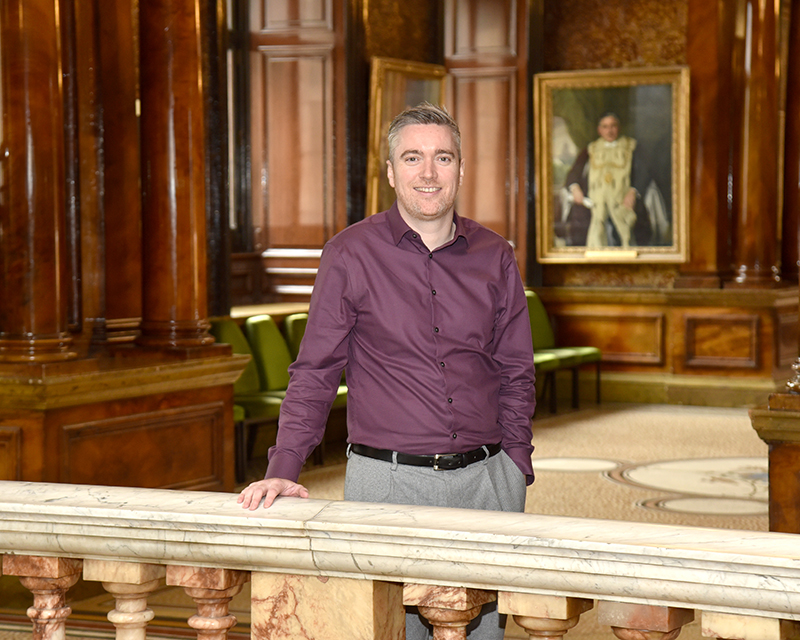
THE new deputy leader of Glasgow City Council has told Project Scotland that the local authority intends on working more directly with the construction sector to solve pressing infrastructure needs in the city and get more people into work.
Councillor Ruairi Kelly said he acknowledges valid criticisms of the city – but insists that it can be turned around, as he eyes an ‘open door’ policy for contractors and developers, shared land-remediation efforts, and lobbying for national tax incentives and streamlined planning regulations.
“Looking across Glasgow, there’s definitely not enough cranes,” he said. “We need to line up land and projects because there’s nothing like a strong construction sector to lift predominantly working-class fellas out of poverty and give them a career that they can be really successful in, that gives them a purpose, and really a life that heavy industry doesn’t offer anymore; a strong construction sector can do that.”
Noting that this won’t happen overnight, councillor Kelly, who previously worked as a health and safety manager at Brand Access Solutions (formerly Lyndon SGB), said that Glasgow could be about to enter a ‘really exciting’ period in terms of development – albeit in ‘some of the most inhospitable economic circumstances ever seen’, but there is still cause for optimism.
“Glasgow isn’t anywhere near what we want it to be,” he continued. “However, there’s a unique selling point for Glasgow in that there’s lots of cities that don’t have anywhere near the availability of land that Glasgow does – and if we’re able to work in partnership with industry, we can release a lot more land for development.”
Glasgow currently has a total of 767 hectares of vacant and derelict land. By contrast, Edinburgh has 131 hectares, Liverpool 494.96 hectares, and Manchester 403 hectares.
First-of-its-kind work in Scotland has been sparked at one derelict site at Cowlairs in the north of Glasgow. Over 1,000 homes will be delivered on the council-owned site, which has been vacant for over three decades. Forming a joint venture liability partnership with the Scottish National Investment Bank and Aviva Capital Partners, the initiative allows the council to remain a co-owner of the site and have a say in what gets built – whilst also removing some of the risk from developers investing in what has been identified as a ‘complex and challenging’ site.
“There’s work to be done to remediate sites to ensure they are viable propositions for housebuilders and we’re working through the sites that are in our ownership,” councillor Kelly added, with the local authority holding between 200-250 hectares of the city’s overall 767 hectares of vacant land. “We can either bring those sites to the market or go into partnerships, as we have done at Cowlairs. That gives us a bit more control over the pace of the building and it also helps us take more of the risk on. We’re not expecting the industry to take all that risk – and if we can share it, then it helps everybody speed things up.”
Acknowledging there was a point in recent times where the council’s planning department was understaffed, councillor Kelly said it is now back at full headcount. However, the complexity of applications and increased amounts of regulations are complicating things.
“That’s not something that we have control over, but we will speak to the Scottish Government and make representation on areas where we believe we could help simplify the process,” he revealed, with areas such as disproportionate standards on social housing builds – compared to private developments – set to be targeted, as well as more fluid approaches to funding, to enable developers to mitigate material cost spikes and abrupt inflation.
“Getting things through planning isn’t the end of it – what was feasible six months ago ends up not being, by the time it’s through the system,” he continued. “That’s why we need to get the impact funding sorted out to address the cost of financing and ensure things are getting through as quickly as possible – but I also think there’s got to be even greater tax incentives, which we (as a council) can’t offer.”
If successfully lobbied, such tax incentives would be targeted at turning city centre commercial units into residential entities – as part of the council’s efforts to increase the centre’s population to 40,000 by 2035. This, councillor Kelly said, could also help curb the rising anti-social behaviour in the city centre, which has seen a dispersal zone set up. Aiming to have pockets of the centre replicate the feel of Dennistoun, and areas of the west end and southside, people would live, socialise, and access amenities such as schools and GPs – thus also activating more passive surveillance and ensuring constant footfall in currently isolated areas where crime thrives.
The plans could potentially allow developers to write off investment against their tax returns in empty buildings that are transformed for residential use – creating an ecosystem of constant redevelopment of vacant buildings, with ‘thousands and thousands’ of homes potentially being created.
“I don’t want to have a city centre that’s just students and retirees – there has to be everything in between,” councillor Kelly stated, before pointing how family living is considered normal in continental city centres. “I don’t want people to feel the need to leave Glasgow to go to East Renfrewshire or East Dunbartonshire to bring a family up. We want a thriving city centre, but that can’t happen if people are just visiting once or twice a month – it needs people in it day in, day out.”
Councillor Kelly concluded by reiterating the ‘doors open’ policy to the construction sector. “We want the perception of Glasgow to be a place to do business – that we’re very much open for business, outward looking, and engaging with the construction sector. We need the construction industry to be firing on all cylinders for us to achieve our aims and aspirations for the city.”