


ELECTRICITY prices in the UK are putting British steelmakers at an ‘increasingly severe’ disadvantage, a new UK Steel report has warned.
The report, Competitive electricity prices: a prerequisite for reindustrialisation, found that British steel producers are paying £91/MWh for electricity in 2026/27 – compared with just £61/MWh in France and £79/MWh in Germany.
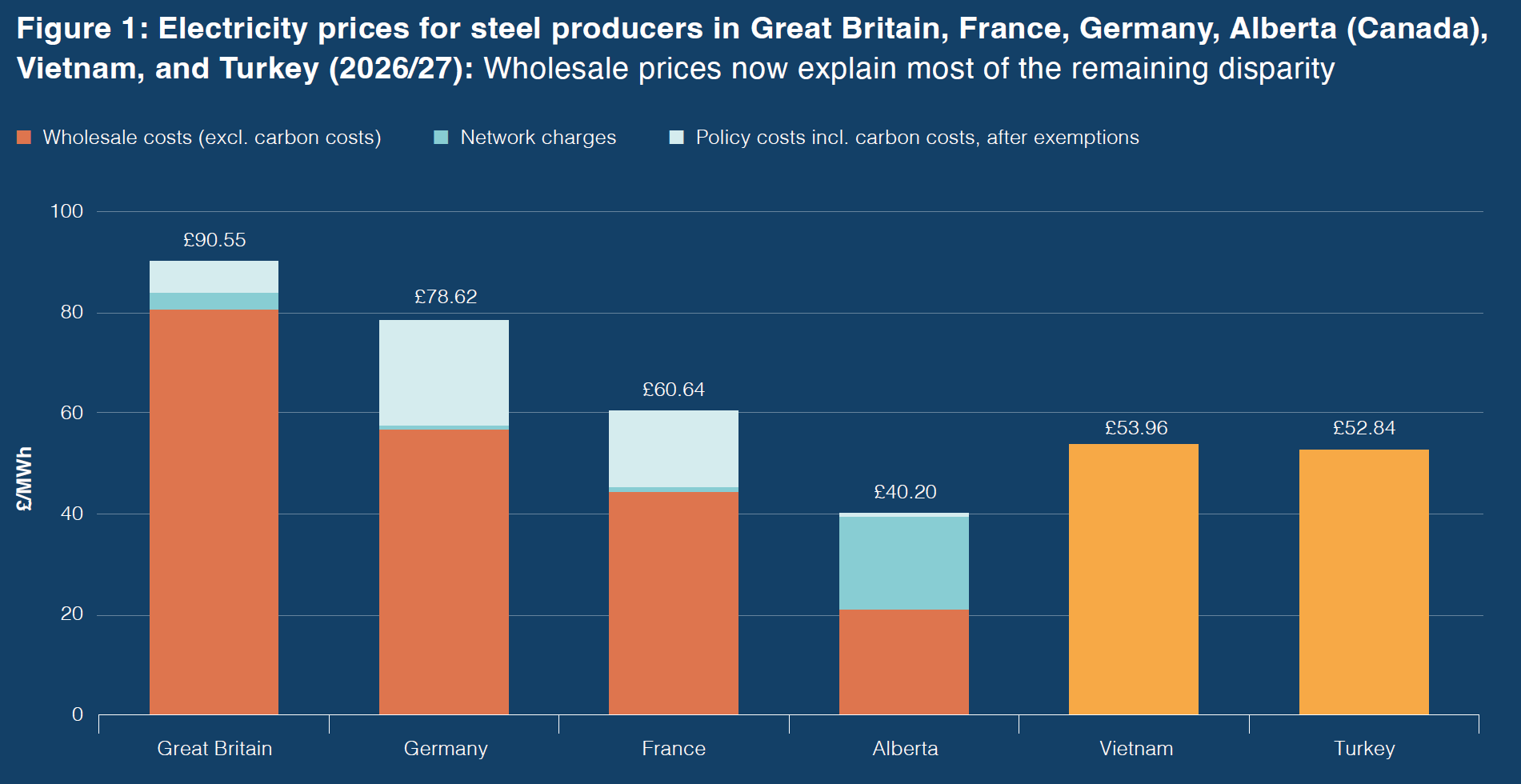
The disparity with France has widened despite recent Government interventions, as high wholesale electricity costs continue to undermine British industry’s competitiveness, UK Steel warned.
The picture is even more stark internationally, it continued – UK steelmakers face electricity prices 125% higher than producers in Alberta, Canada, 68% higher than Vietnam, and 71% higher than Turkey.
The gap with France alone will cost British steelmakers an additional £66 million in 2026/27, bringing the cumulative additional cost since 2017/18 to an estimated £917 million, the report states.
Independent modelling by energy consultancy Baringa identifies a wholesale electricity price rebalancing mechanism that would align British industrial electricity prices with those faced by European competitors.
The mechanism would compensate energy-intensive industries when British wholesale prices are higher, but require payments back when British prices fall below the European benchmark.
UK Steel said that the proposed scheme would cost an estimated £51 million annually between 2026 and 2030, equivalent to approximately 42p per UK household per year. Furthermore, it is forecast to generate a net financial return averaging £13 million annually between 2031 and 2035 – rather than becoming a permanent one-way subsidy.
Peter Brennan, director general of UK Steel, said, “British steelmakers are being asked to compete with one hand tied behind their backs. Despite welcome Government action, our electricity prices remain vastly higher than those of our European and global competitors, and the gap with France is getting worse.
“Fixing this problem need not be difficult or expensive. For the equivalent of just 42p per household a year, the Government could level the playing field for a strategically vital industry, unlocking investment, supporting thousands of skilled jobs, and giving British steelmakers a fighting chance against international competition.
“Our proposal is a two-way mechanism that protects industry when British prices are uncompetitive and returns money when they fall below European levels. It is a practical, affordable solution that could be delivered quickly.
“The Government has rightly made reindustrialisation a national priority. But we cannot rebuild British manufacturing while forcing our steelmakers to pay substantially more for electricity than their competitors.
In response to the report, Carles Rovira, CEO of 7 Steel UK, said, “Competitive electricity prices are fundamental to unlocking the next generation of investment in UK steelmaking. As the UK’s largest working electric arc furnace (EAF) steelmaker, our operations are highly sensitive to wholesale electricity prices. While we are committed to a long-term future in UK steel production, sustained investment in capacity, productivity and decarbonisation will depend on a policy framework that delivers internationally competitive electricity costs.
“The scale of our energy demand highlights the importance of internationally competitive electricity prices. In 2025, 7 Steel UK consumed roughly the same amount of electricity as 145,000 UK homes, equivalent to the annual household demand of a city the size of Cardiff. For energy-intensive manufacturers, electricity costs directly influence the commercial decisions that shape future investment, production capacity and the transition to lower-carbon steelmaking.
“Reforming wholesale electricity costs is therefore an important part of creating the conditions for investment. The benefits need to reach beyond individual steelworks, supporting the wider supply chains that depend on a competitive domestic steel industry. This should go hand in hand with broader policy measures, including procurement that supports a competitive environment for UK businesses and gives domestic producers a stronger platform from which to grow.
“The government’s steel strategy and commitment to reindustrialisation is a welcome recognition of the importance of steelmaking to the UK’s industrial future. However, businesses need more clarity on how the strategy will be delivered and what practical measures they can expect. Clear commitments and a credible route to implementation would help give steelmakers and their supply chains the confidence to plan and invest for the long term.
“The UK has an opportunity to support a resilient, competitive steel industry that contributes to the country’s wider industrial ambitions. Delivering that will require action on electricity costs alongside a broader policy environment that makes investing and producing steel in the UK a commercially viable proposition.”