

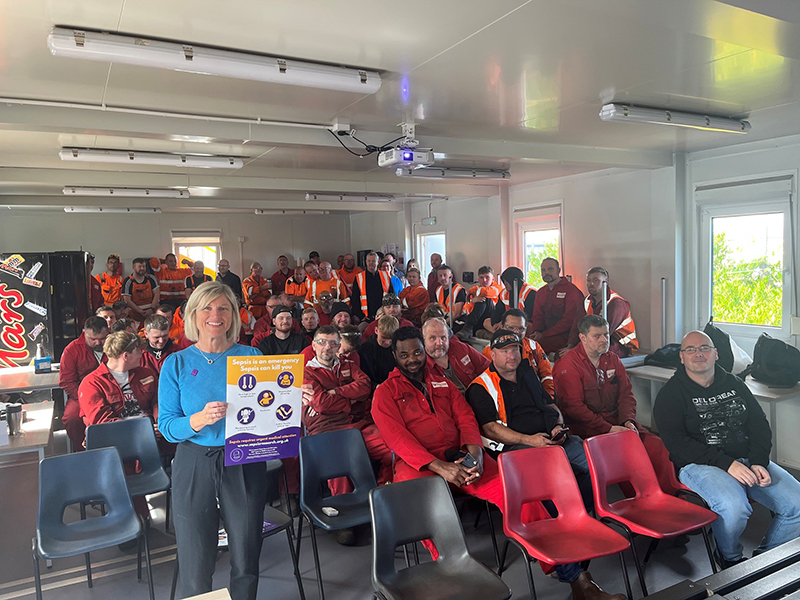
A new health and safety training partnership is launching to help construction workers recognise the early warning signs of sepsis.
The move was inspired by Brian Hume, health and safety manager at Balfour Beatty Scotland, who survived a serious episode of sepsis earlier this year following a gallbladder infection that led to three hospital admissions and, ultimately, intensive care at Hairmyres Hospital in East Kilbride.
Brian, who has worked in health and safety on civil engineering sites for decades, is sharing his story with his own workforce. He has brought together Traffi, a hand protection and safety glove specialist, and Sepsis Research, a leading charity dedicated to funding research and raising public awareness of the condition, in order to build sepsis awareness directly into existing site safety training.
Sepsis is a medical emergency that kills an estimated 50,000 people in the UK every year.
A minor cut, graze or puncture on a construction site can become a serious infection fast. Whilst Traffi’s safety gloves offer hand protection that is designed to prevent such injuries, sepsis awareness training aims to equip workers to stay vigilant in the event of an injury. It will help workforces recognise when a wound, however minor, has stopped healing as it should and needs urgent attention. It was that connection, between preventing the wound and staying alert once one occurs, that led Brian to introduce the two organisations.
“I’ve spent my career telling people on site to report every cut, every graze, every near miss,” he said. “Sepsis is exactly why. On a site like ours, where injuries happen, any infection – from a graze or wound that doesn’t heal, or like in my case, a gallbladder complication or the flu – can turn into sepsis within days. I’m sharing my story because it could save someone.”

Stephen Moore, CEO of Sepsis Research, added, “Sepsis sits right at the centre of the conversation about workforce health and economic resilience. It remains the leading cause of preventable death in the UK, and for the 50% of survivors who face long-term physical or psychological effects – from limb loss to PTSD – the impact doesn’t end at hospital discharge. Real progress against sepsis depends on three things working together: preventing infections before they take hold, diagnosing sepsis early when it does, extending the critical window for treatment, and ensuring survivors get the treatment and long-term support they need.”
The training, developed jointly by Sepsis Research and Traffi, will be rolled out to construction site teams across Scotland this September, and made available to Traffi’s wider customer base in the coming months. It builds sepsis recognition into existing hand safety and injury-prevention training, using the same approach that underpins Traffi’s red-amber-green TraffiSystem, whilst helping workers spot the signs of sepsis before it becomes a medical emergency.
Wesley Dempster, aftersales team lead at Traffi, said, “Our mission has always been prevention – reducing hand injuries at the source, before they ever have the chance to become something more serious. A cut or a wound that goes unnoticed or untreated is exactly the kind of everyday risk that can escalate into sepsis, so building sepsis awareness into our safety training is a natural extension of the work we already do. We’re proud to bring our approach to hands-on, practical training into this partnership, and to help workers prevent, recognise and respond to sepsis risk before it becomes a medical emergency.”
As part of the launch, Brian has recorded a short video sharing his story, which will be played during on-site training sessions and shared across the partners’ social channels throughout Sepsis Awareness Month, and beyond.
The common symptoms of sepsis in adults are:
- A very high or low body temperature
- Vomiting and diarrhoea
- Uncontrollable shivering
- Confusion or disorientation
- Passing less urine than normal
- Extreme pain or discomfort
- Blotchy, cold or discoloured skin
- Fast, or difficulty in, breathing
- Rapid heartbeat
- Feeling dizzy or faint
- The feeling that you are going to die