

Caitriona Jordan, associate director for retrofit and energy efficiency at BE-ST, shares practical lessons in quality and training that have emerged from Tier 1 contractors working on large and complex Passivhaus projects in Scotland
WITH the next consultation on the Scottish Passivhaus Equivalent now underway, it is great to be able to share the positive message of the Delivering Quality paper recently published jointly by BE-ST and the Passivhaus Trust.
Passivhaus places strong emphasis on clear performance targets, coordinated design development, rigorous testing, and documented verification. Passivhaus certification provides an independent ‘golden thread’ of input throughout the design and construction process. By engaging with this process-driven methodology, Tier 1 contractors have developed practical solutions in quality management, coordination and evidence capture that materially reduce performance risk. These are distilled in the Delivering Quality paper.
Testing out ideas and solutions
Working on Passivhaus projects in Scotland has led to impressive levels of collaboration amongst Tier 1 contractors. A number of companies were working on Passivhaus schools that required steel frame construction. At the time of project development, there were limited examples of large-scale steel frame Passivhaus buildings in the education sector. This represented a significant project risk given the perceived complexities of steel interfaces for thermal and airtightness detailing.
To ensure construction went well and smoothly, the contractors got together to develop a steel test rig at our BE-ST training facility near Glasgow. The completed rig was a fixed structure, and its development was led by Morrison Construction. The process involved off-site optioneering of detail and component feasibility involving suppliers, design team and sub-contractors. Controlled air-testing of the developing solution in a purpose-built test rig allowed the team to identify weak points in the details and resolve them in a controlled environment.
The steel rig helped them try out three different steel frame scenarios and enabled them to develop a workable solution, which has been employed at several Scottish Passivhaus schools, including Morrison Construction’s Faifley Campus project and Balfour Beatty’s Nairn Academy.
The TTARRDIS (testing, training, and research rig for design development, installation, and sequencing)
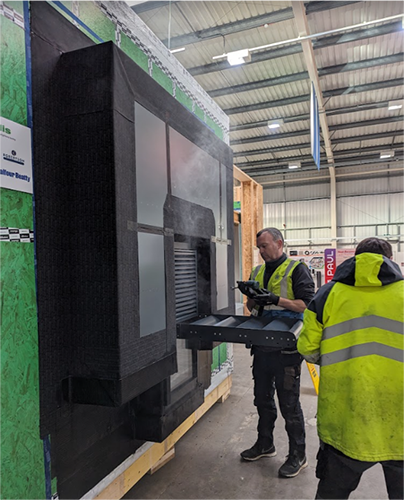
A second rig (affectionally known as the TTARRDIS) was developed at BE-ST and was used as a key training tool for the contractors and their subcontractors. The TTARRDIS is a timber frame cube (designed to the Passivhaus standard) with key openings and cut-outs to allow for testing of various details and constructions, one example being a louvre detail.
The TTARRDIS was designed to enable the supply chain to input into the details and educate and upskill themselves ahead of site installation. (It) is used for testing various interfaces with site-based operatives, including ground slab, external wall, openings and roof construction. This pre-site training approach resulted in no defects or abortive works when installed on site.
Mock-ups and prototypes give workers hands-on experience, set expectations before work commences, and have been found to substantially de-risk the process. The earlier in the programme, the more effective they can be. Early-stage mock-ups allow all relevant parties to be part of the development and make it possible to establish a best practice approach that can be integrated into the construction drawings.
Training
BE-ST has continued to build on these relationships with Tier 1 contractors to develop further training using these rigs. Delivered by BE-ST in partnership with Balfour Beatty and funded by the CITB Industry Impact Fund, the Low Carbon Passport is a first-of-its-kind, accredited training programme equipping 1,200 construction professionals with essential low carbon skills.
It is zero-cost, CITB and industry-backed. It has been developed in tandem with Tier 1 contractors, led by Balfour Beatty, where contractors contribute by reviewing content, provide feedback and providing insight into the demand and requirements for the training.
BE-ST have also led and coordinated bringing the programme to colleges across Scotland, creating a college delivery network for Low Carbon Passport which includes City of Glasgow College, Inverness College, Borders College, South Lanarkshire College, Dundee and Angus College, West College Scotland and West Lothian College. Outside of Scotland, the Low Carbon Passport has been delivered across the UK in working with the colleges in Greater Manchester and London.
BE-ST also delivers, alongside trusted training provider Coaction Training CIC, Passivhaus Practical Training designed for Tier 1 and Tier 2 contractors, architects, consultants and tradespeople delivering buildings at scale using bespoke training rigs. The one-day training course equips participants with the knowledge and insight to align design intent with practical implementation, enhance collaboration across teams and contribute to the successful delivery of energy efficient, high performing buildings.
Delivering Quality
Delivering Quality is a free resource for the wider construction industry, sharing best practice approaches. The paper’s lead author is Allan Smith from Morrison Construction, and it has been written with a working group including BE-ST and Tier 1 contractors drawn from Morrison Construction, Balfour Beatty, Kier Construction and Robertson Construction.
• The Delivering Quality Paper is FREE to download at https://www.be-st.build/news/delivering-quality