
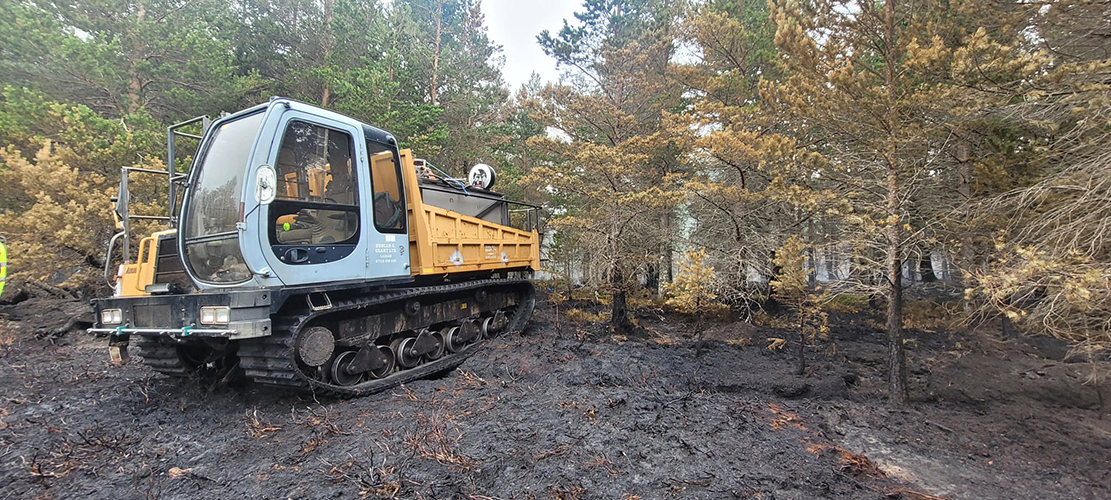
EAST Lothian-based Evans Engineering Solutions helped to tackle the recent Cairngorms wildfire after supplying a customised machine described as ‘one of the best firefighting kits you could ask for’.
The devastating wildfire, which started in mid-July, impacted an estimated 25 square kilometres of the Cairngorms National Park, with over 500 firefighters tackling the blaze at its peak, alongside a number of volunteers and a range of specialist equipment including heavy construction machines.
One piece of kit utilised was a 15-tonne Morooka tracked dumper, customised by Evans on behalf of customer Duncan G Grant. Work started on the solution prior to the wildfire, due to the forestry contractor’s awareness of the increasing risk of such fires.
The Morooka dumper was revamped to carry 4,000 litres of water and have three pumps running – one high-flow, two-inch pump and two additional fogging units that produce a mist spray – with both pumps combining to produce a longer-range cannon on the front.
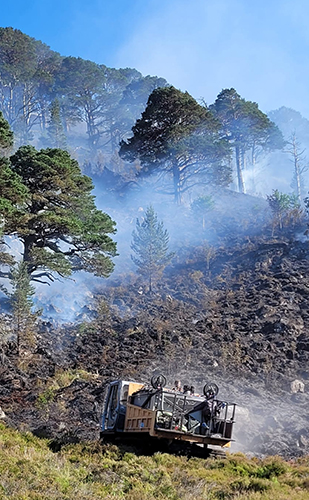
Evans worked alongside Duncan Grant, MD of Duncan G Grant, who has a great deal of experience operating on hillsides like those found in the Cairngorms.
“It’s doing what we hoped it would,” Gareth Evans, MD of Evans Engineering Solutions, revealed, before praising the performance of the Morooka in manoeuvring the tough ground of the mountain range. “It’s giving us a capability to be out on the hill a bit longer. A lot of it’s quite remote spots, so it’s not always easy to get water – and stopping to get water can take a long time. It also gives us capabilities to take water out and share it with others who are out there fighting the fires. Because we carry so much water, we can be a tender for the smaller vehicles.”
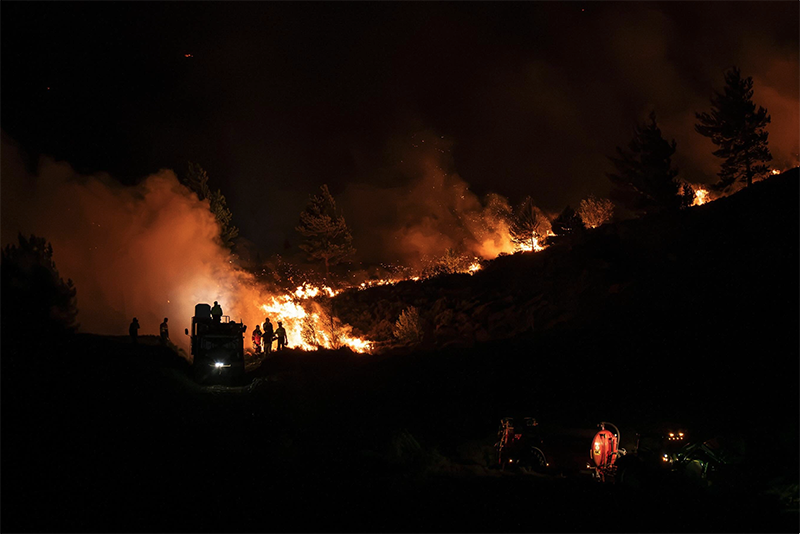
Bright Spark Burning Techniques – an Inverness-based training, consultancy and emergency response firm focused on heather burning and wildfire mitigation – praised the machine’s capabilities. The dumper has been assisting in the response, operated in tandem by both Gareth and Duncan, as well as Angus Grant and the wider Duncan G Grant team.
Despite the impressive performance, Gareth insists the machine solution remains an ‘ongoing project’. He, alongside welder Callum Wiley, worked two nightshifts to get the model on site by July 17, after receiving a call two days prior to see if it would be ready.
“In all honesty, it was nowhere near ready,” Gareth revealed, adding that it was initially meant to be a long-term project whereby the machine would be altered based on user experience. “We’re an engineering firm, but have a background in farming and hill work, so we understand the challenges and something we feel strongly about is the firefighting aspect of wildfires.”
With wildfires surging across Europe, research by the Met Office suggests they will become increasingly common in Britain. With that in mind, Gareth is anticipating further work in the years ahead to help mitigate the impact of such incidents.
Each situation is likely to require its own bespoke solution, based on factors including ground terrain.
“This has been a good stepping stone for us to potentially help other contractors with solutions,” Gareth added. “There are different (fire) scenarios that you’re up against and each one is going to require slight alterations to the machines.”
Plant and construction firms from across Scotland were praised for their ‘exceptional’ response to the devastating wildfires. Scottish Land & Estates revealed it received dozens of responses from contractors to its urgent call for assistance – resulting in a ‘substantial’ register of heavy plant, specialist vehicles, and personnel within hours. The Highland Council announced on July 25 that enough heavy machinery and plant had been sourced to battle the blaze – thanking those who responded to the situation.