

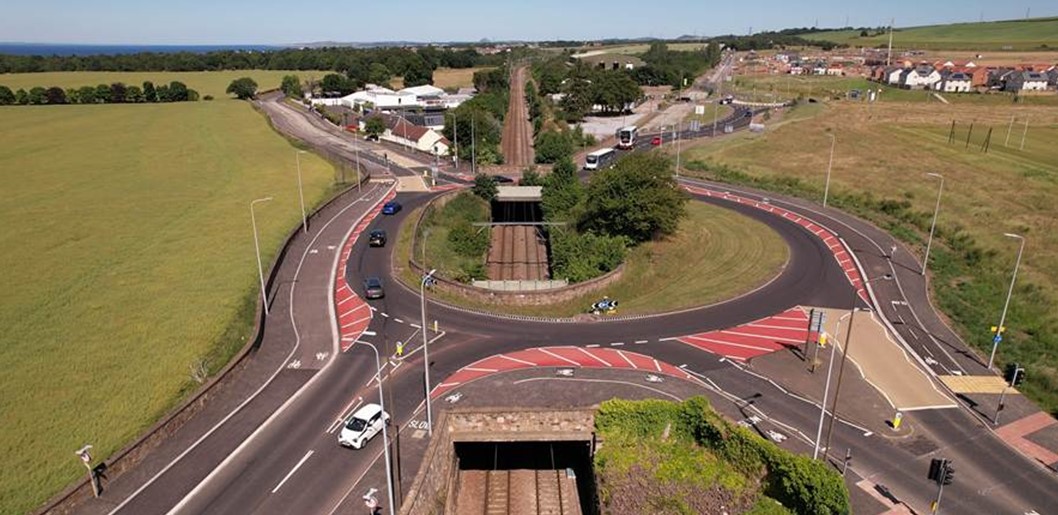
WHEN Akela Construction was appointed principal contractor for the £1.2 million Wallyford Toll Roundabout Improvement Scheme, MD Robert Ogg knew his team wasn’t going to be just reshaping a busy junction, they were constructing a vital infrastructure improvement for East Lothian’s sustainable future.
Funded predominantly by Transport Scotland’s Active Travel Infrastructure Fund and procured via the Scottish Government Dynamic Purchasing System (DPS), the five-month project for East Lothian Council was a critical cog in the region’s active travel agenda. Situated as a key hub connecting local schools, new residential developments, and the A1 corridor, the roundabout required a multi-modal upgrade.
Akela revealed how it completed the project after balancing multiple phases of complex live-traffic management, active travel infrastructure delivery, and overcoming a number of unforeseen surprises.
“At its heart, the Wallyford Toll upgrade was designed to fundamentally shift how the local community moved,” said Robert Ogg. “The core objective was to break down reliance on private vehicles by providing high-quality, segregated alternatives for pedestrians, cyclists, and wheelers.”
Akela delivered carriageway alterations and a reconfiguration of the roundabout’s geometry. The team also installed dedicated cycleway infrastructure and upgraded footways.
To avoid seriously impacting the transport network, Akela adopted a multi-phase, flexible construction methodology. The junction accommodates substantial commuter volumes and forms an important route for numerous bus services.
“A primary success criterion was keeping every single scheduled bus route and school transport operation running without interruption throughout the five-month duration,” added Robert Ogg. “To hit this goal and minimise peak-time congestion, we moved high-impact operations – including major carriageway reconstruction and final road surfacing – entirely to evening and nightshift windows.”
One of the challenges was the site’s close proximity to the local high school. Every morning and afternoon, the construction zone became the main thoroughfare for hundreds of pupils going to and from the school.
“To guarantee safety without disrupting foot traffic, we carefully synchronised our most disruptive heavy plant operations to avoid peak school travel hours entirely. Our team deployed robust, clearly signposted temporary footways, segregated working zones, and highly visible, controlled crossing points, ensuring that the youngest active travel users were able to navigate the shifting dynamics of the site with confidence.”
As excavations progressed, the team encountered a series of significant legacy issues that increased the original project scope and meant the re-programming of works and traffic management on multiple occasions.
Excavation work revealed legacy coal tar materials running through sections of the old road structure. Akela implemented an environmental management strategy, undertaking rapid material testing, careful segregation and secure transport to licensed specialist disposal facilities.
Multiple live gas leaks were identified within the work area. Akela established emergency coordination with the gas network operator to secure repairs while safely maintaining progress on adjacent site zones. The existing street lighting network was also found to be in poor condition and required upgrading. Coupled with delays surrounding the installation of new Scottish Power infrastructure, Akela said its project management team had to be ‘agile’ with regards to programme management and works scheduling.
Looking at the transformed Wallyford Toll Roundabout today, Akela described the benefits to the community as ‘stark’. Robert said, “We firmly believe that Akela Construction has delivered a safer, significantly more resilient junction that successfully balances improved traffic flow for motorists with class-leading active travel infrastructure.”
An East Lothian Council spokesperson said, “The improvements at the Wallyford Toll Roundabout were designed to make it easier for pedestrians and cyclists to travel between Prestonpans, Wallyford, Musselburgh and Tranent. The aim of the project was to improve accessibility for active travel while also enhancing traffic flows.
“Council officers worked closely and successfully with Akela Construction over a number of months to ensure the project was completed safely and with the minimum possible disruption for the benefit of East Lothian’s residents. The final design achieved a positive balance between protecting the long-term viability of existing bus services and delivering substantial active travel enhancements.”
A Scottish Government spokesperson added, “It’s fantastic to see the successful delivery of the Wallyford Toll Roundabout Improvement Scheme. As a project procured through the Scottish Government’s Civil Engineering Dynamic Purchasing System, it demonstrates the value that collaborative procurement can bring. By providing access to a pre-qualified and competitive supplier market through a streamlined route to market, the DPS helped support effective collaboration between East Lothian Council and its delivery partner while maintaining competition, quality and value for money.”