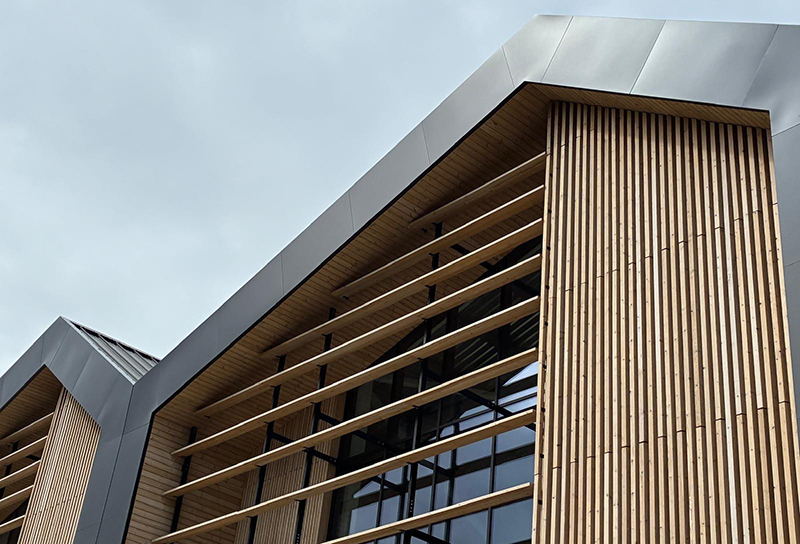
Gary Robson, business development manager at EJOT UK, highlights the potential of stainless steel framing systems to create higher performing, safer and more sustainable rear-ventilated facades
REAR-ventilated or rainscreen façade systems are increasingly important in Scottish construction due to their suitability for both new build and refurbishment schemes, and how they can enable more stringent building performance standards to be achieved. Product innovation, however, is driving even better performance and quality, particularly in terms of substructure design and composition.
The substructure is a combination of brackets, rails, fasteners and anchors which creates the cavity to accommodate the ever increased depths of insulation and ventilation. It is typically manufactured using aluminium, largely due to this material’s high strength-to-weight ratio, corrosion resistance and widespread availability. However, in an era of higher performance standards and the urgent need to maximise sustainability in the built environment, stainless steel represents a better all-round choice for this vital façade system component.
One such all-stainless steel system is EJOT CROSSFIX. This European Technical Assessment (ETA) certified system has proved itself in projects around the world, including for constructing the thermally superior facades of two large apartment buildings within the Climate Innovation District in Leeds.

Providing higher load capacity and façade stability
EJOT CROSSFIX achieves high strength, load-bearing capacity and structural stability because it utilises stainless steel’s greater rigidity in combination with innovative bracket geometry, designed to support L and T-shaped profiles, and optimised anchor load distribution. This provides an engineered solution capable of carrying heavier facade loads with fewer brackets, with the system’s optional ‘Powerkey’ helping distribute wind and dead loads evenly across the anchors to maximise overall load capacity.
Significant reduction in thermal bridging
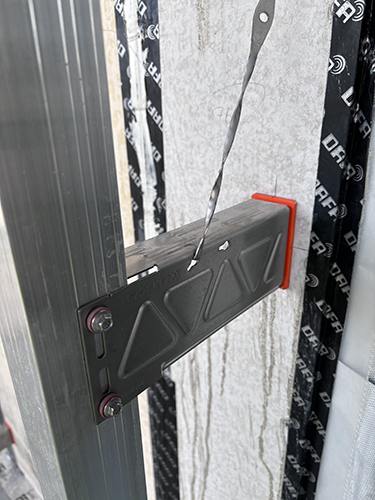
A major benefit of stainless steel for façade subframes is that it has a lower thermal transmission compared to aluminium – reducing heat transfer between the building structure and external cladding sheets. In addition, CROSSFIX incorporates a polyamide thermal stop in the Konsole bracket to further improve resistance to heat transfer.
Low thermal conductivity means a reduction in thermal bridging, which can be so significant that higher thermal performance in the façade may be achieved without increasing the insulation depth. Alternatively, thinner insulation can be used to achieve the initial U-value for the façade.
Reduced demand on resources
Using thinner insulation enables significant savings to be achieved on the façade’s insulation volumes and cost. Also, given the higher strength of stainless steel, fewer brackets are needed when using a system like CROSSFIX – that means fewer components and less installation time. Important commercial benefits can also be leveraged here as a thinner façade overall could enable floor space to be increased within the building to maximise returns for sale or rental.
Stainless steel is also fit for the closed loop economy given its easy recyclability. End-of-life recovery rates for this metal in construction as a whole are close to 100%, and the material can be remelted repeatedly in electric arc furnaces without any loss of strength, corrosion resistance or metallurgical quality.
Higher level of fire resistance
Stainless steel retains its strength comparatively well at higher temperatures, aligning well with the construction industry’s new building safety regime and projects where the highest possible fire resistance is a priority.
It has a starting melting point at temperatures no lower than 1375 °C and retains a high degree of mechanical strength durability at high temperatures. As a result, the CROSSFIX system is classified with an A1 fire rating according to EN 13501-1, the highest possible classification for non-combustible materials, signifying that it does not contribute to the spread of fire.
Greater design flexibility
The innovative design of the CROSSFIX system adds further potential for streamlining future façade projects because the Konsole bracket is engineered for both vertical and horizontal rails – offering much greater design flexibility compared with ‘helping hand’ brackets that accept a rail in one direction only.
This enables better alignment with cladding formats and an ability to optimise fixing locations for improved aesthetics, and it offers adaptability to simplify working with complex building geometries, façade variations and evolving material choices. More efficient load distribution may also be achieved without redesigning the substructure, and greater tolerance is offered for uneven surfaces and easier on-site alignment – all resulting in quicker installation, cleaner finishes and less need for adjustments.