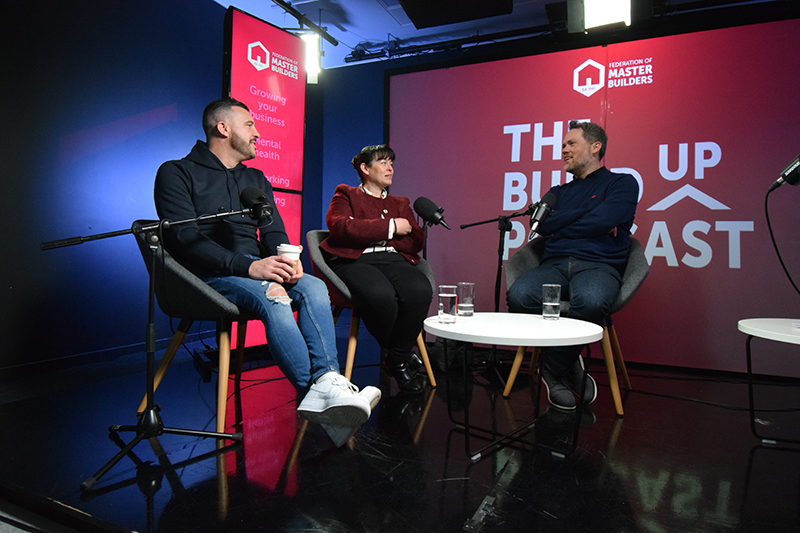
A Federation of Master Builders (FMB) member has marked Mental Health Awareness Week by opening up about his own struggles in a new FMB podcast in which he urges the construction sector to break its culture of silence.
David Gutierrez, director of Nest Building Group and FMB London director, described how he experienced a ‘mini breakdown’ after two years of struggling in silence.
“I felt like I just didn’t want to get out of bed,” he said. “I didn’t want to move.”
Gutierrez recalled a bricklayer he followed online who seemed to have everything going for him. “What a fantastic bricklayer he was. Personality wise, he was fantastic. Everything just was all there. And he took his own life. Why? Because we don’t talk. We’re in our own heads.”
Co-host Aidan Cropper, MD of Ipsum UK, echoed the sentiment: “You can be slipping down this slippery slope of depression really and get yourself into a real unhappy situation. And often you might not feel like there’s a way out.”
The episode comes as figures reveal the scale of the mental health crisis facing construction workers. Research from the Chartered Institute of Building (CIOB) shows 94% of workers experienced stress over the past year, with 83% suffering anxiety and 60% experiencing depression. Nearly three in ten reported experiencing suicidal thoughts.
Brian Berry, chief executive of the FMB, said, “Mental health in construction is no longer something we can sweep under the carpet. The statistics are stark and sobering. Too many skilled tradespeople are suffering in silence because they don’t feel they can ask for help.
“Small building firms are the backbone of this industry, and employers have a responsibility to create environments where workers feel safe to speak up. That means having honest conversations, training managers to spot the warning signs, and making sure everyone knows what support is available. Breaking the stigma starts with us.”
For Gutierrez, the turning point came when he opened up. “The first person I opened up to was actually my wife, which was the biggest step,” he said. “My children need a dad and my wife needs a husband. Before it gets any worse, I needed to make a change.”
Sarah Bolton, CEO of the Lighthouse Charity, added, “Mental Health Awareness Week helps shine a spotlight on all of the amazing work that is being done to promote a positive mental health culture in our industry. Our key message is to encourage individuals to reach out for support at an early stage, no matter what the issue. We have a number of routes to support including our 24/7 helpline and live web chat service along with a self support app and our Lighthouse Beacons.”
The FMB has developed mental health resources for small building firms, including toolbox talks, signposting to support services, and guidance on creating mentally healthy workplaces.