

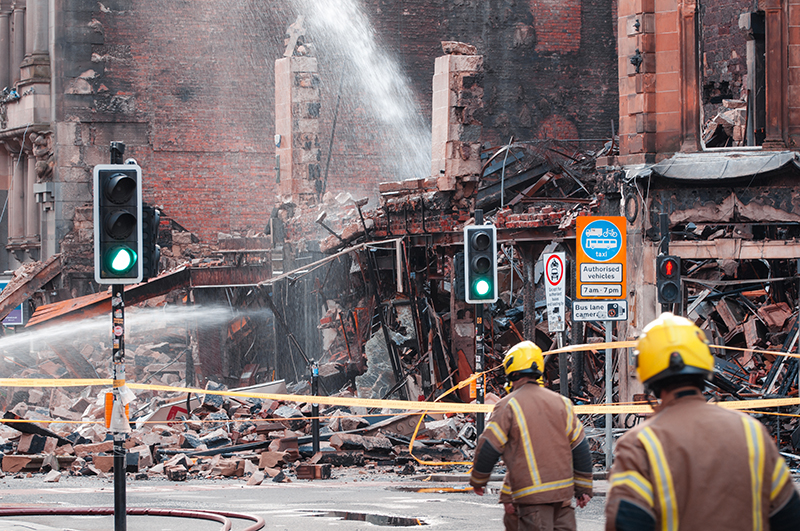
FAÇADE retention was ‘impossible’ on Glasgow’s fire-damaged Forsyth House with the charred and water-damaged structure creating perilous conditions for specialist contractors who worked 24/7 to clear the city centre site, Project Scotland has been told.
The B-listed building, constructed in 1851 and redesigned in 1896, was left significantly damaged following the devastating Union Corner fire on March 8.
Four days after the blaze, Glasgow City Council’s Building Standards & Public Safety team concluded demolition of the unstable remnant of the historic building – located next to Scotland’s busiest railway station – must happen in the interests of public safety.
Project Scotland recently spoke to Raymond Barlow, head of building standards at the council, about the complex recovery response. He explained that it was ‘far too dangerous’ to attempt to save the historic building devastated by fire on the corner of Union Street.
“The structure had already massively collapsed and what was left was essentially free-standing,” he said. “There were no floors tying it all in and the surrounding elements were gone. The freestanding remnant (had) been badly damaged by the fire itself coupled with the effects of high-pressure jet hosing.”
Raymond, who has worked at Glasgow City Council for over three decades, also led the local authority’s response to the second fire at The Glasgow School of Art in 2018. The building owners, at their own expense, encapsulated it in a large retention scaffolding, enabling the structure to be temporarily stabilised and saved.
“They were able to consider doing so because of the way the structure was still hanging together; it still had a concrete slab at the top storey level – if that concrete slab wasn’t there, in my opinion, the building would’ve fully collapsed,” Raymond said. “They were able to work their way through gradually and put a bird’s nest around it at one end and a different structural bracing system at the other.
“That worked in that building (but) it would not work here – our assessments confirmed that and the contractor confirmed it was not prepared to put its operatives in to attempt retention work because of the ongoing threat of collapse.”
The council and contractor’s caution was proved correct. For example, the southern gable survived the initial fire but subsequently suffered uncontrolled collapse, causing the four-storey structure to hurtle toward areas where operatives could have been working had a façade retention been attempted.
The council took control of the area from Scottish Fire and Rescue Service on March 12. Using a Scotland Excel framework, it was able to have contractor Burnfield Demolition on site that same day. The framework enables local authorities to have specialist contractors on call to react immediately to emergency issues, rather than embark on potentially lengthy procurement processes.
“The contractor had already been through the whole checking and approval process,” Raymond explained. “As far as I’m concerned, they’ve done an excellent job. We initially had them working 24 hours a day because of the importance of re-opening Glasgow Central Station, the effect on the economy of Glasgow, and disruption on surrounding businesses and streets.”
The demolition operation has been no mean feat. As of March 27, 14 18-tonne vehicles of rubble were being excavated daily. Some 120,000 people use the neighbouring Glasgow Central Railway Station each day – with the station sitting both beside and underneath the site.
“You have a lot of unknowns in such circumstances,” Raymond continued. “With buildings that are so old, you think you know – but they can easily catch you out.
“You may think that one part is separate from another and (have) no initial concerns… then you find out there is an interconnection and need to re-think operations.”
This was seen at the western gable, which remained in place. The team discovered that despite the collapsed building being built first, there are structural interdependencies between Forsyth House and Voco Grand Central Hotel. if it were to be taken down, it would damage the structure of the hotel – albeit to a minor extent.
“They’re (project team) still in the process of design and our staff are working with the hotel, going into their side of the building with their structural engineers. We are trying to fully establish what the wall construction is and to then decide what is the best method of stabilisation,” Raymond explained.
“What we’re also wary of is that the grab from the machine undertaking rubble clearing isn’t just gripping a piece of collapsed structure steel and pulling it, only to find it’s still attached to the gable for instance. It’s a very gradual operation and we haven’t therefore gotten down to the basement level yet. Due to this gradual process we’re having difficulties predicting what the end date will be for the works.”
Despite the uncertainty and disappointment over the inability to retain the façade, Raymond praised the response from the public to the works, including the way people embraced the council’s specialised communication strategy, which was first shaped in response to the 2018 Victoria’s nightclub fire on Sauchiehall Street.
The aim is to provide quick and direct messaging to hopefully quell speculation and possible misinformation. The council’s webpage for the incident provides regular updates and contacts for any affected parties. It is said to have been instrumental in being able to provide affected businesses with a contact to request the financial assistance being provided by the Scottish Government.
By March 11, before the site was even in control of Glasgow City Council, Raymond had provided a video statement that attracted hundreds of thousands of views, in which he detailed the immediate assumptions following an initial assessment and put a face to the works. Council leader Susan Aitken later released a similar video to announce the building would be demolished.
“It always helps, particularly in the modern, digital age with instant communication,” Raymond said. “In my opinion it has worked really well. People speculate; it’s natural and you have to put everything else aside and get the right information out.”
Whilst no definitive end date can be given for the recovery response, Raymond revealed there will be no let-up in work as efforts continue to help pave the way for future reconstruction of this significant area of the city centre.