
A London-based architectural designer whose concept design for Glasgow’s fire-damaged Union Corner went viral on social media is hoping others in the profession use their skillset to help spark discourse amongst Glaswegians on what they want from the impending rebuild.
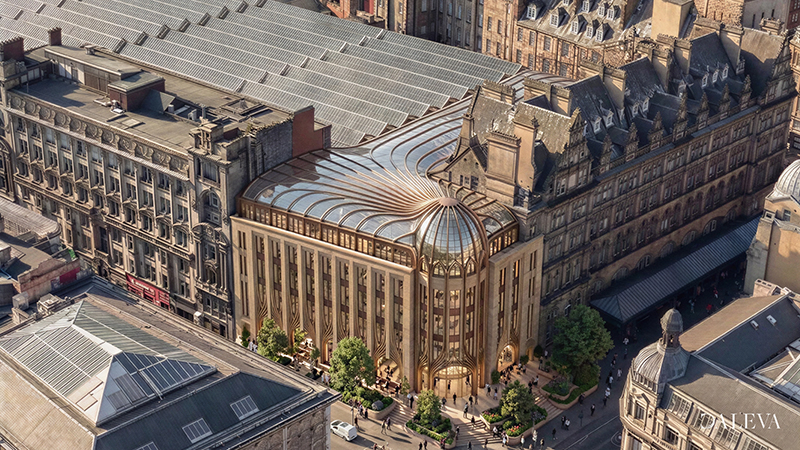
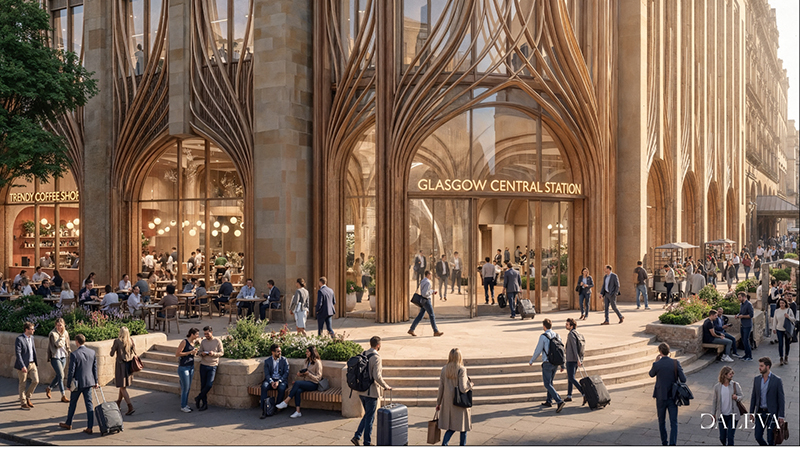
Rada Daleva, whose partner is from Glasgow, racked up hundreds of thousands of views and responses to her proposal for a contemporary civic landmark, which would look to honour the memory of the original Victorian structure whilst opening up the area to better public space, active ground floor uses, and a grander entrance to Glasgow Central Railway Station.
“The proposal is not by any means a final one or something I see as being complete – it is a conversation starter,” she told Project Scotland. “I really want to spark wider conversations, understand what people feel and what they want in that location – the people of Glasgow feel strongly about their city and feel pride in it, so I think there is a great opportunity to get them involved.”
The sight of the Union Street building burning evoked strong emotion amongst those in Glasgow. A prominent city centre landmark, it pre-dates Glasgow Central and was recognisable for its timber-framed, lead-clad dome.
Such emotion is what Rada believes has sparked the response to her concept designs and she is now urging other architects to use their skills to come up with their own iterations – to ensure that whatever does replace it has been crafted in the vision of Glaswegians.
Rada, whose portfolio includes work on the Aston Martin F1 headquarters and the creation of bespoke furniture via her Daleva Design brand, was previously a project lead at Studio Tim Fu before pivoting to focus more on her independent studio.
Studio Tim Fu specialises in the integration of AI in its projects, with Rada having worked on its delivery of what has been heralded as the ‘world’s first fully AI-driven architectural project’ in Slovenia – with the technology being an ‘active design collaborator’ throughout.
Key to the brief was basing the 22,000 sqm housing development on traditional Slovenian typology, with AI able to identify patterns and present hundreds of design concepts.
Rada used AI to create her Glasgow Central concept design, which she explained allowed her to produce it in a matter of days as opposed to what would take weeks using traditional methods.
“There were a lot of iterations – and that’s important to get across to people so they understand how AI is used,” she continued. “Yes, it’s very fast – but if you want to dictate it in a certain direction, you have quite a bit of control over it and that’s what I want to put across as a designer.”
Many of Rada’s design prompts were centred around the Victorian buildings in and around Union Street, as well as the work of acclaimed Glasgow architect, Charles Rennie Macintosh. The glass structure was inspired by the previous building’s dome, whilst the wider design was based upon the prominence of turrets in Scottish architecture.
Though the resulting images look like a final render, Rada explained that it should be treated as a sketch – a ‘really, really realistic’ sketch, at that. “When you move to the latter stages, you start using traditional architectural processes,” she continued – explaining that it is a tool, rather than a complete replacement.
Clients have reacted positively to use of AI, Rada revealed – with the design process able to evolve quickly without being bogged down with complex procedures and terminology that can sometimes distance clients from the process.
“That’s what AI is really helpful with – it allows for a lot of different options and iterations. That’s going to help with the community (engagement) because we can deliver a lot of different options to them and have it vetted by them – and that’ll require a lot less time and cost that it usually would.”
With the Scottish Government pledging £10 million to the response to the Union Corner fire and Glasgow City Council vowing to be ‘ambitious’ with the rebuild, Rada hopes that architects – regardless of their chosen methods – will look to spark the same conversations she has on her social media channels.
“Glasgow was a world leader (in architecture) and it needs to have a place on the global stage again, because it deserves it,” she concluded. “I love Glasgow; it has beautiful culture and buildings. The other thing is its people – they are direct, honest, and personable; and that’s a big part of why I like Glasgow so much.”