
SCOTLAND’S net zero drive is set to be boosted by a new facility at West College Scotland (WCS) created through a collaboration between major players in the construction sector.
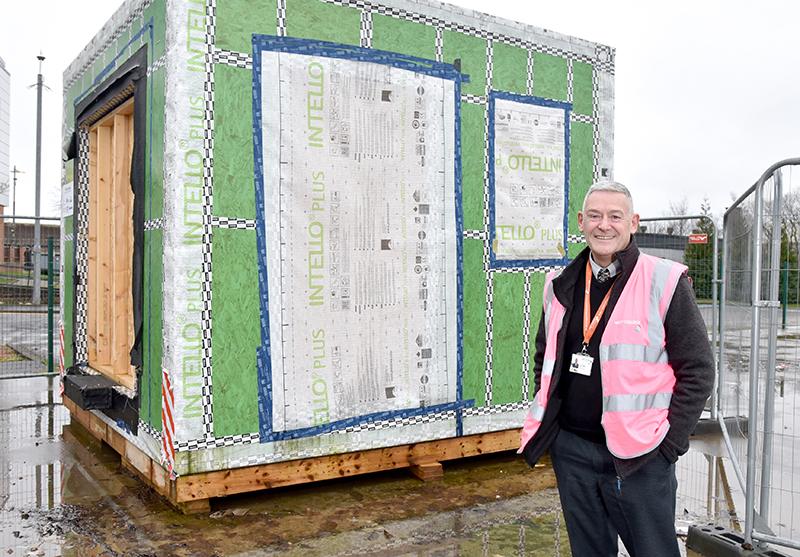
The TTARRDIS (testing, training, and research rig for design development, installation, and sequencing) – a thermal imaging test bay designed to develop thermal principles and air tightness – was produced by Built Environment – Smarter Transformation (BE-ST), Morrison Construction, Kier, Robertson, Morgan Sindall, Balfour Beatty, and their collective supply chain.
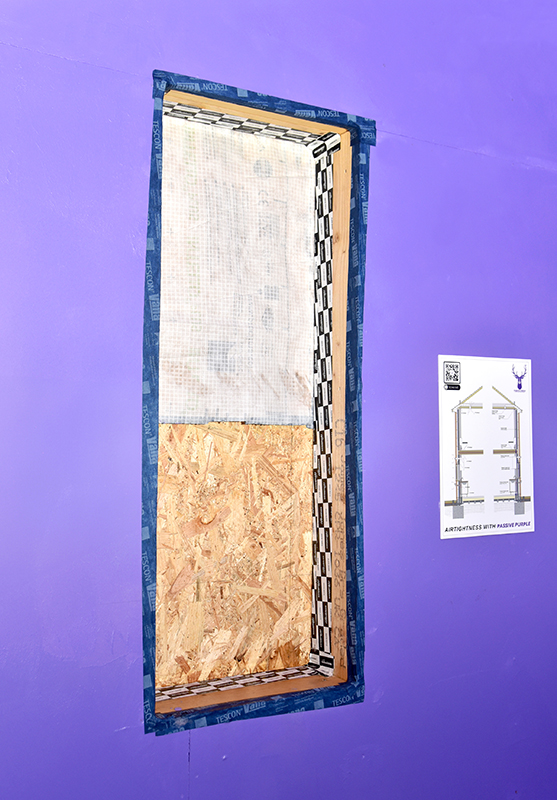
The timber framed test rig is designed to trial the latest construction methods and materials in relation to air tightness and heat retention, allowing for the creation of real-life data on the true performance of approaches to buildings.
Designed to be a central test point for industry, the facility – and different iterations of it – has been used to help influence Morrison Construction’s Passivhaus Faifley Community Campus and Paisley Grammar School projects, as well as Balfour Beatty’s Nairn Academy project and Kier’s build of the new Currie Community High School.
“Morrison Construction is pleased to have played such a vital role in the design and development of the TTARRDIS,” a spokesperson from the company told Project Scotland, adding that it has proven to be an ‘invaluable testing environment for developing and resolving complex detailing’ with the firm’s supply chain, giving collective confidence to proceed to construction with the new innovative solution. “We are delighted that now the TTARRDIS will continue to be used by students to enhance and aid practical knowledge of such an important area for the industry.”
The use of thermography, blower fans, and smoke machines can provide instant results to work carried out in the TTARRDIS, highlighting issues such as air gaps at window details or in joints, as well as identifying thermal bridges.
Now located at West College Scotland’s Paisley Campus – adjacent to Morrison’s build of the new Paisley Grammar School – Nicola Murray, head of construction and building services at the college, told Project Scotland the learning institute is extremely grateful for the ‘outstanding’ gift.
“The TTARRDIS thermal imaging test bay will give our staff and students access to industry-leading facilities, helping to unlock student potential and support future success,” she explained.
Students will soon be able to test their knowledge and skills on the facility, with it set to form part of a wider Eco Village planned for the site.
“Typically, you’d test students within a classroom environment – with information on a board,” Derek Smillie, curriculum quality leader for construction at West College Scotland, added. “The TTARRDIS represents more than a test facility; it represents an opportunity. It allows our students to gain real practical insight into modern construction standards whilst strengthening the connection between industry and education and towards net zero.”
Hailing the construction partners for their commitment to education, Derek said the donation of The TTARRDIS further strengthens the link between education and industry and will ensure that the sector has access to the staff ‘they need now instead of tomorrow’.
“The industry increasingly needs work-ready graduates who understand performance, compliance, and sustainability,” Derek continued. “The TTARRDIS aligns learning with real world expectation.
“Employers want young people to have that knowledge, because it’s the future – these (environmental) rules and regulations aren’t going to go away; they’re only going to get stronger.”
WCS is increasingly collaborating with industry. On the morning of Project Scotland’s visit, an employers’ event had been held which involved seven construction firms talking to students about future opportunities.
The Paisley Campus features a CECA Scotland Academy, which offers a pathway to becoming a qualified civil engineering operative. Morrison Construction is sponsor of its foundation apprenticeship programme, which sees students make benches for the new Paisley Grammar School. Elsewhere, companies including Deans Civil Engineering and WH Malcolm Group have donated building materials for learning projects.
“It’s brought massive development on, not just for the students, but the staff as well,” Derek said. “The building industry is changing every single day in terms of materials, products, and processes. The lecturers have to keep up to date with all this, and this is also giving them a better understanding of what they’re teaching to students.”