

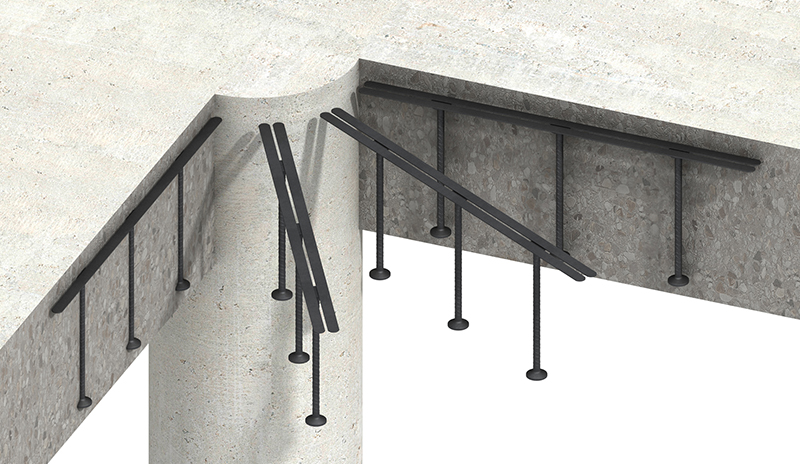
Harriet Cotton, research & development engineer, forming & reinforcing at Leviat, tells Project Scotland about addressing punching shear risks
PUNCHING shear is one of the most sudden and catastrophic risks in reinforced concrete flat slabs, and typically occurs around column supports under concentrated loads. It can develop with little visible warning, and in extreme cases, trigger disproportionate or progressive collapse. Historical failures in South Korea, the US and UK have shown how design weaknesses, construction errors, and environmental exposure can result in progressive collapse.
With modern projects featuring thinner slabs, wider spans, and heavier loads, managing punching shear risk is becoming increasingly relevant for both engineers and architects.
Why punching shear failure is different
Punching shear failure differs fundamentally from more familiar flexural (bending) failure in reinforced concrete. Flexural failure is typically ductile and accompanied by visible cracking and deflection, whereas punching shear failure can occur abruptly once critical cracking develops around a column. When this happens, load transfer is lost over a small area, but the consequences can extend far beyond the immediate connection.
In flat slab systems, where load paths are highly concentrated, the ability of the structure to redistribute forces following such a failure may be limited, increasing the risk of disproportionate collapse.
Learning from structural failure
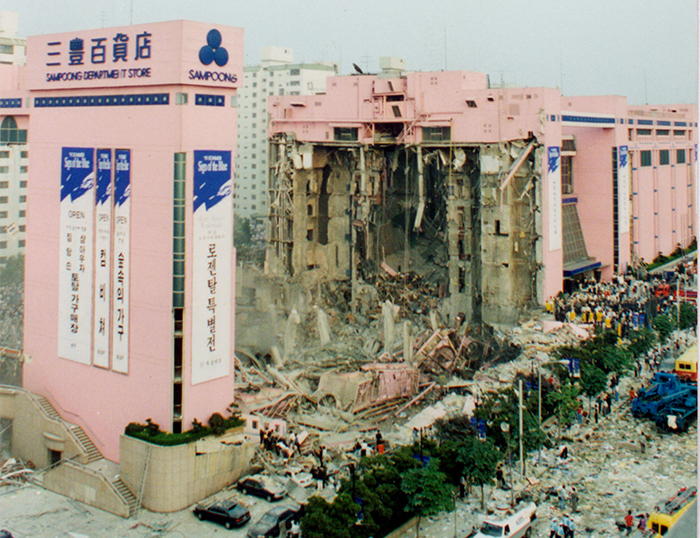
The Sampoong Department Store collapse in Seoul has become one of the most cited punching shear failures. Design alterations, reduced slab thickness and increased loading combined to overwhelm slab column connections that lacked sufficient robustness.
More recently in 2021, the Champlain Towers South Collapse in Miami highlighted a number of contributing factors including deterioration of concrete, reinforcement corrosion, and the performance of slab–column connections in the pool deck area, where punching shear has been suggested as a possible mechanism.
In Wolverhampton, the Pipers Row Car Park failure revealed how local deterioration of the concrete at the slab-column connection alone, without exceptional loading, can critically reduce punching shear capacity over time.
Together these cases show that punching shear failure is rarely caused by a single oversight. It typically results from inadequate design, construction deficiencies, changes in use, or long-term deterioration.
Evolving pressures on flat slab design
Current design trends have intensified the risks. Thinner slabs, wider column spacings and heavier floor loads are now commonplace, driven by architectural flexibility, sustainability objectives and economic pressures. Post-tensioned flat slabs, which allow reduced slab thickness, add further complexity to punching shear design and detailing around columns.
In new construction, these demands require careful consideration of punching shear from the earliest design stages. However, the greater challenge increasingly lies with existing buildings. Many UK flat slab structures were designed to earlier standards, with lower imposed loads and limited consideration of future adaptation. Today, these buildings are often expected to accommodate additional plant, heavier loads or structural alterations.
Ageing mechanisms such as carbonation-induced corrosion, loss of cover, and freeze–thaw damage can significantly reduce effective capacity. The Pipers Row collapse demonstrates that punching shear failure does not necessarily require high loading as deterioration alone may be sufficient to initiate collapse.
Eurocode 2 and a more behaviour-based approach
The introduction of the second generation of Eurocode 2 represents an important shift in punching shear design, moving away from empirical rules towards a more mechanics-based approach founded on Critical Shear Crack Theory (CSCT). By adopting control perimeters that closely reflect punching shear failure, the revised framework captures more of the underlying physical behaviour of slabs. While the resulting checks remain complex, they allow punching shear verification to be more closely informed by detailed analysis, including finite element modelling, and support more realistic assessment of non-standard designs and existing structures than was possible under the first generation of the code.
Assessing and managing punching shear risk
Assessing existing flat slab buildings demands a careful and systematic approach. Modern assessment practice increasingly combines detailed analysis with targeted investigation to establish realistic punching shear demand and capacity. Where construction deficiencies are identified, strengthening may be required to restore acceptable safety margins. Punching shear strengthening techniques, including stud rail systems, have been extensively tested and supported by guidance and certification, offering verified safety performance when correctly designed and installed.
Effective strengthening depends on a sound understanding of punching shear behaviour, appropriate modelling assumptions, and clear detailing that considers constructability and load transfer. It requires more than simply adding reinforcement, but applying it intelligently within a robust engineering framework.
Improving practice
Punching shear failures remind us that structural safety depends on understanding behaviour, not just meeting minimum rules. For engineers and specifiers designing or working with concrete structures, punching shear deserves careful attention at every stage of design and construction. Applying the lessons from historic failures, alongside proven reinforcement systems, robust analysis and digital tools, can significantly reduce the risk of sudden, disproportionate collapse in flat slab structures.