Lizzy Westmacott, associate director at ECD Architects, shares how the industry can fast-track its Passivhaus know-how ahead of upcoming policy changes
THE Scottish Government has recently issued an update on its Passivhaus Equivalent policy, ahead of a consultation to be held later in 2026. Amongst other very positive indications, it is looking almost certain that Passivhaus certified projects will be considered ‘deemed to satisfy’ Scottish building standards, possibly implemented before March 2028.
Passivhaus delivers outstandingly comfortable and energy efficient homes and buildings. The Scottish Government is to be applauded for its climate leadership, joining Australia in its recognition of Passivhaus as ‘deemed to satisfy’ building standards. Alongside other policy levers being drawn up to improve building performance, as part of the Passivhaus Equivalent policy, this move will have a significant impact on demand for Passivhaus homes and buildings in Scotland. Now is the time for the Scottish construction industry to upskill in readiness!
Help is at hand
Once you’ve undertaken a Passivhaus project, there is no going back, but there is an inevitable steep learning curve on a first project. That is why it really is essential to have at least one Passivhaus-experienced member of the project team to reduce these growing pains. The good news is that there is an established Passivhaus community that can help!
The Passivhaus Trust has nearly 600 members across the UK, from manufacturers to Passivhaus designers. I have genuinely found it a really supportive bunch of people, who want us all to succeed. As well as training and guidance, tailored support for social housing providers is provided.
ECD has been working with the Passivhaus methodology since 2011. We can take on the role of either Passivhaus architects, Passivhaus consultants or Passivhaus certifiers, depending on what support a project needs. Some of our recent Passivhaus projects demonstrate the range of support that can be of assistance to both experienced and novice Passivhaus teams.
We’ve been working as Passivhaus consultant on a recently-completed 90-unit social housing project for Midlothian Council in Newbattle. In this role, we have worked alongside the project architects supplying building physics and PHPP modelling. This is a model that could be replicated across Scotland for architects embarking on their first Passivhaus project.
The Passivhaus consultant would ‘hold the hand’ of the architect throughout the process and help tweak designs to optimise Passivhaus performance.
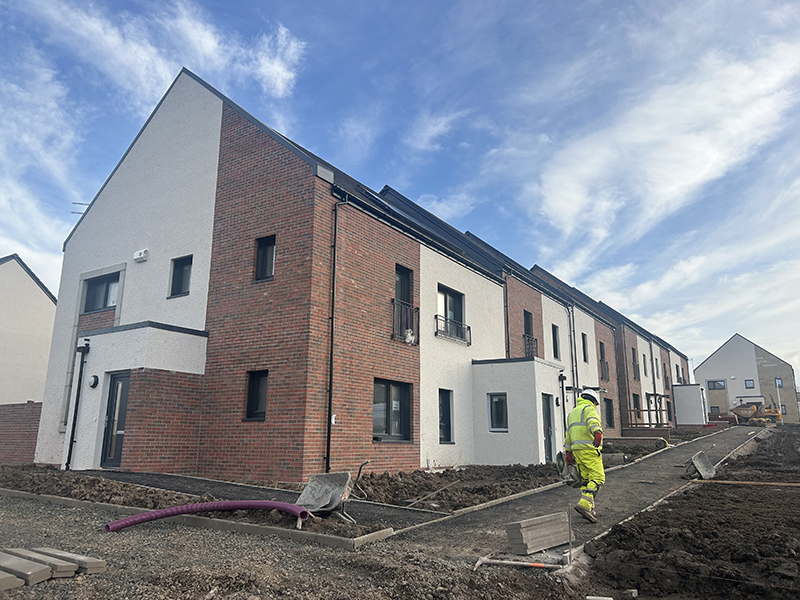
Our Passivhaus social housing project of 15 houses for East Dunbartonshire Council in Twechar is currently on site. For this project, we are acting as both Passivhaus architect and designer, providing both architectural design and Passivhaus modelling. The advantage of tackling both architectural design and Passivhaus elements is that core Passivhaus principles are naturally integrated into the design from the outset. This solution acts as something of a ‘one-stop shop’ for clients who want to hand over the project to an experienced Passivhaus team.
In our role as Passivhaus certifiers, we recently completed our work supporting the 597-home Shanganagh Castle Estate project in Dublin. A certifier acts as an independent verifier of the work of the Passivhaus designer/ consultant and can help the project team through the certification process. If brought in early enough, the certifier can flag up any major problems and offer guidance for ways the project can be tweaked to achieve certification.
Schools leading the way
We are also working as Passivhaus consultants on Scottish Passivhaus schools including Liberton High School and Alloa Community Campus. The Scottish Passivhaus schools programme currently underway demonstrates that the construction industry CAN quickly pivot to Passivhaus and it is not the seismic shift that people might fear, more a series of incremental changes to building and design practices.
Solutions can be found
Our recent Passivhaus project experience also demonstrates that even on constrained sites with complex issues, difficulties can be overcome and Passivhaus certification can be achieved. At our social housing project at Twechar for East Dunbartonshire, the site’s narrow, linear shape, steep topography, protected trees, and proximity to the canal posed challenges for site orientation and form factor.
Our experience shows that it is possible to make Passivhaus work in almost any situation. There are two ways towards Passivhaus certification – either working to the criteria for space heating demand (kWh/m2/year) or heating load (W/m2). The heating load route offers flexibility for constrained Passivhaus projects.
Embrace Passivhaus!
Scotland accepting Passivhaus standard as ‘deemed to satisfy’ building standards will be a game-changing and world-leading policy.
We at ECD would encourage Scottish projects to aim for the certified Passivhaus standard, through the deemed to satisfy route, so that we reap the full Passivhaus benefits as a country in years to come
This is such an exciting opportunity for Scotland to build the homes we deserve – homes that actually perform as intended. The industry has shown that we can do this, the climate crisis dictates that we need to, so let’s do it.