

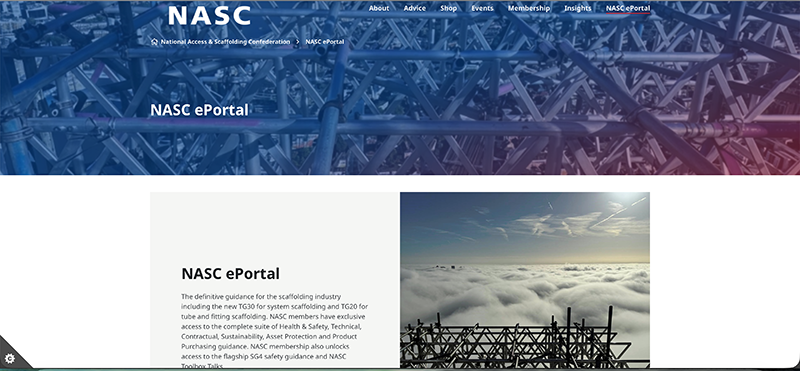
THE NASC has provided Project Scotland with details of a new digital era for the organisation, designed to provide a raft of benefits to members.
A new app is launching, which will provide news and information to scaffolders and sector stakeholders, while NASC members and CISRS cardholders will notice things look different when they visit the websites. Members, cardholders and training centres all have to log in for the first time and update their security credentials.
CEO Clive Dickin revealed there are ‘many reasons’ for the investment in a new digital infrastructure for NASC and CISRS, which will allow for the first time the creation of a single, joined-up digital ecosystem, with one massive factor being security.
He explained that the new system will be built to incorporate the latest security standards, designed to help make life easier and safer for anyone interacting with it.
“By building on an existing, tried and tested platform that is specifically designed for membership organisations and trade bodies, we can incorporate elements such as Single Sign On (SSO) and Two-Factor Authentication (2FA). These are widely used standards that enhance both ease of use and security,” Clive stated.

The project has been led internally at NASC by head of technical Mark Collinson, who added that the use of one system that is fully joined up and complies with the latest cyber security standards should be a plus for member firms.
“Our members are used to having to meet Cyber Essentials plus and other, similar standards, especially if they want to tender for government work or public sector contracts,” he said. “They are well established as procurement standards across the industry.
“It’s a massive plus for them to be confident that the entire new NASC and CISRS digital infrastructure, including the ePortal, meets these requirements and will be maintained to keep up to date as the standards develop over time.”

As with any transition to a new system, NASC told Project Scotland there may be some extra effort required as part of the initial sign-in and set-up process. And while it may look a little different, the site should still be familiar. Thereafter login to the whole ecosystem should be simpler and more straightforward.
Dickin added, “Since we started on this project we have seen several major disruptions, not least the Jaguar Land Rover hack, which halted production for several months. Through our ePortal, which is also part of this new platform, members are downloading some 14,000 compliance sheets a month. The impact of not being able to issue a compliance sheet for three months would be devastating.”
The system is built on the concept of having one central location for everything. “This is the foundation of the new system,” Collinson said. “The reality is that the way we interact with each other and with organisations has changed. This is the dawning of a new era for the scaffolding industry, one where we are really embracing the future and looking ahead to the needs of future generations of scaffolders.”
NASC said it has always embraced new technologies and continually developed its ePortal over recent years, with the latest addition of TG30 helping to bring the total of downloaded compliance sheets over the 500,000 mark.
Collinson added that the organisation is very comfortable with the digital environment and has seen firsthand that the industry is also keen to embrace it.
One advantage of the new ecosystem, which includes the launch of a dedicated new app – ScaffPal – will be ease of use.
“A great example is the digitalisation of CISRS cards,” Collinson added. “From about March onwards, the ScaffPal app will be home to your digital CISRS card and as long as you have the app downloaded on your phone and have your phone on you, you will always have your CISRS card with you. No more hassle when you leave your wallet at home. You will be able to use your phone to get on site. We are also looking at a range of other practical tools to add in over time to make the app as valuable as possible.”
Dickin went on to explain that the move is also about making life as easy as possible for employers and training centres. “The digital cards will always be up to date with someone’s latest training and qualifications. It will make life easier and safer for everyone. There remain some major issues at the moment with the use of fraudulent cards, and this should help to reduce that problem.
“We are also working hard so that the new ScaffAcademy, a digital learning management system, will eventually be a core part of the ecosystem. It means that everything is joined up, to the benefit of learners, training centres, employees and employers.”
Another upgrade will be a move away from generalised, broadcast publishing to more ‘nuanced, personalised, targeted’ content. “When you go onto the website at the moment it’s a one-size-fits-all approach,” Collinson said. “With the new system we’re using what’s called conditional content. This means that depending on your profile and the topics you have selected when you first register, you’ll only see the content and key messages that are most relevant to you.”
This more targeted approach will also carry through onto the ScaffPal app.
“This will really transform how we engage with and communicate with NASC members and the wider CISRS community,” said Dickin. “We have to recognise that the world has been mobile-first for some time now. It’s no longer enough to base our operations around the assumption that people want to read emails. People want information in lots of different ways, and we need to embrace that multi-channel culture if we want to keep engaging with the younger generation of scaffolders.”