

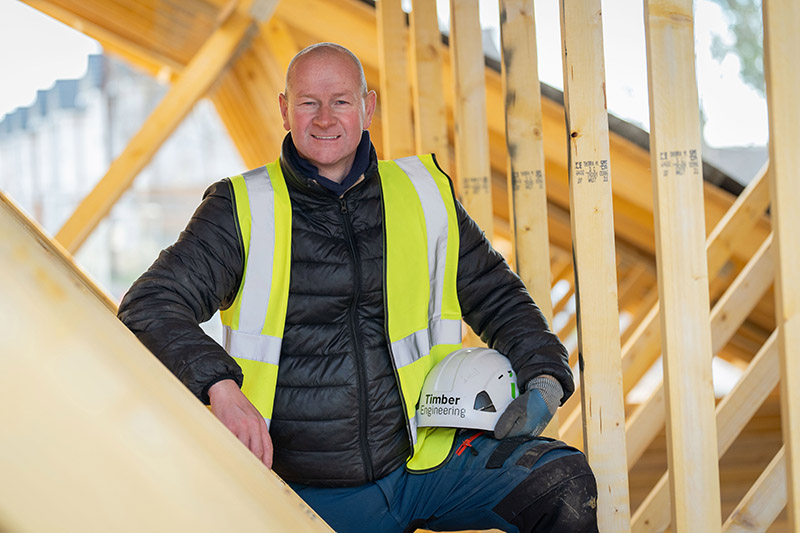
Eddie Wighton, founder & director of Timber Engineering, tells Project Scotland about the steps he believes the government could take to help alleviate the housing emergency
Q) What, in your view, should the Scottish Government be doing to tackle the housing emergency?
A) Engagement with those who actually create homes in Scotland is vital and, in my view, would be the most effective way to stimulate meaningful progress in tackling the housing emergency. By this, I do not mean discussions with special advisers or employers’ agents, but with those directly responsible for the design and construction of new homes.
Architects, engineers, developers and, in particular, SME housebuilders are the people spending every working hour fighting to deliver change. They have the experience, knowledge and expertise to make a real difference. They innovate, push the boundaries of what is possible, create regional employment, boost local economies and continually strive to do better.
SMEs hold the key to growth in the sector, with both the desire and the ability to scale when the right conditions are in place. We must also remember that this crisis does not only affect social housing and those who deliver it. It is impacting housing across all tenures and affecting a huge number of families across the country.
Q) What factors could help speed up delivery of quality homes?
A) There are many challenges facing our industry right now, but we must be honest and agree that the current system is not fit for purpose. With the declaration of a national housing emergency, we need to be prepared to rip up the ‘rule book’ and focus on output.
Working collaboratively is key to success and the recent Scottish Government announcement to establish a new National Housing Agency to help speed up and enable the delivery of all housing tenures is very welcome. Further detail on this initiative, known as More Homes Scotland, has now been published and I hope this creates a genuine opportunity for housebuilders and industry leaders at all levels to be involved. I would personally be delighted to contribute. If we work together, we can achieve success.
Alongside this, I believe the Scottish Government should further reshape the political structure around housing delivery. The appointment of a cabinet secretary for housing, Màiri McAllan, has rightly elevated housing as a priority. Perhaps this role should be supported by two dedicated housing ministers. One minister for housing, overseeing private developments and privately funded build to rent schemes, and a minister for social housing, specifically responsible for delivery by local authorities, housing associations and RSLs. While many view housing as one single issue, the delivery processes for each model are vastly different.
I often comment on the lack of understanding around new home construction within the wider community. Housebuilders are not contractors and contractors are not housebuilders. Only those with experience across both sectors fully appreciate the difference. If we begin to recognise these as two distinct industries, we can make significant gains in both output and cost efficiency.
We all appreciate that government must balance many competing challenges when shaping policy, including public finances, the environment, energy provision, utilities and public opinion. However, if we are serious about tackling the housing emergency, compromises will have to be made.
Planning remains one of the biggest barriers to housing delivery and must be addressed seriously. There may be a case for a centralised planning authority to deal with major applications of 100 homes or more, or for intervention where local authorities are under pressure and statutory timescales cannot be met. Planning is complex and as developers we must respect the role and perspective of planning authorities, but collaboration is essential if progress is to be made.
One area I would like to see improved is the removal of subjectivity from the planning process. Applications should either meet policy or they do not. Too often, decisions are influenced by personal opinion, which becomes particularly problematic when planning officers change part way through an application. In the future, there may even be a role for AI in this process. Local authorities could set policy, with applications assessed against that policy by AI in minutes. If an application meets, for example, 95% of the criteria, it could be recommended for approval and passed on for final scrutiny. If it falls short, the applicant would receive a clear report outlining where improvements are required, allowing resubmission in a timely manner. This could transform the planning system for both industry and local authorities.
Local Development Plans should also be updated and ratified as a matter of urgency. During this process, local authorities should allocate sufficient land for housing and this should be the stage at which public consultation takes place. For example, if land capable of supporting 200 homes is allocated for housing, that allocation process should include statutory public engagement. This would allow concerns to be addressed early and ensure the land has been fully assessed as suitable. Once the LDP is adopted, housing land would effectively have outline approval, allowing planning consent to be granted under delegated powers without repeated consultation, significantly speeding up delivery.
Developer contributions are another major issue and, in my view, are killing off genuinely affordable housing delivery. We should be honest about what these are, which is a tax on new homes. Schools, healthcare and similar services are not the responsibility of individual home purchasers, yet these costs are added to the price of a new home and carried throughout the lifetime of a mortgage.
On one of my developments delivering over 100 high-quality family homes, many purchasers already live locally and their children already attend nearby schools. Others are older couples downsizing, freeing up larger homes for the next generation while planning sensibly for later life. These buyers are still being charged additional costs for local services they already have an entitlement to. Only a small percentage of buyers have relocated from outwith the area and arguably increased pressure on local amenities.
I would argue that families relocating into an area should receive a transparent “tax bill” so they can make an informed decision, while those leaving an area should be entitled to a rebate for reducing pressure on local services. The current system is neither fair nor sustainable.
Building standards also remain a challenge to scaling housing delivery. I have previously proposed a fixed standard period, potentially ten years, to allow developers to focus on delivery rather than constant redesign. This would provide long-term certainty, enable repeatability and support training and apprenticeships.
Under this approach, the next standard would begin development in year five, with a two-year industry consultation. Any changes would be limited to a maximum cost increase of 10% to protect affordability. The final standard would be published in year eight, allowing a two-year lead-in period for upskilling before implementation in year ten. This ‘Decade Standard’ would allow the industry to operate at its full potential and increase output year on year.
There are many more ideas across the industry, but in my view, these are the four priorities that would have the greatest impact on accelerating the delivery of quality homes.
Q) What are the benefits of timber frame construction?
A) Timber frame has proven to be a highly successful form of house construction in many countries across the world. In the UK, timber has been used for centuries, from medieval housing through Tudor times and right up to modern timber frame systems. In Scotland, timber frame in its current format has been used for over 40 years, with the majority of homes now constructed this way.
This tried and tested solution offers a far more sustainable option than fully masonry construction, with almost all timber sourced from sustainable forestry processes. While adoption was slower south of the border, many of the UK’s major housebuilders have now fully embraced timber frame.
I am often asked whether timber frame homes are harder to mortgage or insure, based on the misconception that they may be inferior. In reality, timber frame must meet the same standards as any other form of construction and, in some cases, can be superior to masonry builds. All major warranty providers cover timber frame as standard, it is fully compliant with CML requirements and all mainstream mortgage lenders lend on timber frame homes.
Timber frame also allows homes to achieve excellent energy performance. When combined intelligently with appropriate insulation products, U-values can be exceptional. As an example, homes on our developments in Dundee have achieved A-rated EPCs as standard for many years, with the majority now scoring between 98 and 100 for energy efficiency. With renewable heating systems, we also achieve a 100 score for environmental impact.
Another key benefit is speed. Timber frames can be designed early, manufactured off-site and delivered in ready-to-assemble sections. These are erected quickly to create a wind and watertight structure. Reducing build time adds value to a project, as savings are made across overheads, scaffolding, site management and funding costs.
In summary, a high-quality timber frame system is one of the most efficient methods of house construction, with one of the lowest environmental impacts.
Q) What does Timber Engineering specialise in? What type of projects do you take on and how do you stand out from competitors?
A) Timber Engineering UK was initially formed as a spin-out from our housebuilding business, InverTay Homes. I have over 37 years’ experience in construction and work with a highly experienced team across all trades. Unlike many housebuilders, we avoided the pitfalls of a purely subcontracted delivery model, retaining much of our labour and manufacturing capability in-house, including timber frame production.
To further evolve our timber frame system, it made sense to create a standalone company focused solely on this area. That decision has led to significant advances in how we manufacture and erect timber frames on site.
Our core expertise is in housing rather than apartment blocks. These are often referred to as single-family homes, traditionally detached or semi-detached housing, where timber frame can add real value due to speed of construction. When housing design is properly aligned with constructability, the results can be exceptional.
The homes we manufacture for InverTay Homes are designed specifically for efficient construction. The layouts are simpler, with fewer structural walls, yet the homes are larger than comparable new builds. We can erect two houses from foundation to wind and watertight in as little as one day, delivering a significant reduction in overall programme time. This is where we differ from competitors who often rely on more traditional installation methods.
Our process developed by taking a step back and asking how timber frame erection could be faster, simpler and safer. By combining technical knowledge, experience and common sense, we reduced installation times from weeks to days.
The first key stage is design. When this is properly aligned with construction activity, the gains are significant. Too often, housing designs prioritise aesthetics without fully considering build efficiency. This is not a criticism of architects, who are trained in design rather than construction, but it does present challenges on site.
The second stage is communication between the manufacturer and the developer, particularly the site team. Without strong coordination, delays are inevitable.
The installation stage is where everything comes together. Preparation includes setting out foundations, installing DPCs, checking tolerances and assembling floor cassettes at ground level. Roof sections are also assembled on the ground using trusses supplied by specialist manufacturers.
On crane day, all elements arrive on site together. Using the crane for all lifting, our team guides each component into place. Ground floor frames are installed with windows already fitted, followed by floor decks, first-floor frames, insulation and plasterboard, then complete roof sections. By the end of the day, two houses are fully erected to wind and watertight, ready for follow-on trades.
The final stage is inspection and snagging to ensure the system is completed to the required standard.
Timber frame apartments are possible, but once certain height thresholds are exceeded, fire safety regulations and structural interactions with masonry make projects significantly more complex. Differential settlement between timber and masonry, particularly around communal areas such as stairwells and lift cores, introduces additional technical challenges.
Q) What do you see as the biggest challenges and opportunities facing your business over the coming years?
A) None of us has a crystal ball, but I believe many SME housebuilders will cease to exist in the coming years unless the direction of policy changes. Each year, thousands of high-quality construction businesses and skilled workers are lost, many within the housing sector.
This is happening at precisely the time we face a housing emergency and a chronic skills shortage. If this decline continues, it will limit opportunity and constrain growth for businesses like ours.
At the same time, there is a significant opportunity to supply timber frame systems to companies in England and Wales as more SME housebuilders move away from traditional masonry construction. The UK Government has been actively encouraging sustainable construction methods, improved energy efficiency and the adoption of MMC, which is driving greater openness across the sector.
Q) What are some of the wider benefits, both to individuals and society, of delivering high-quality homes?
A) Housing should be the highest priority of any government. While housing is often viewed simply as a place to live, it is far more than a roof over our heads.
Many of society’s biggest challenges are closely linked to housing quality. Health outcomes, pressure on the NHS, child poverty, crime, mental health, educational attainment and support for people with disabilities or neurodiversity challenges are all significantly influenced by the homes people live in.
Without a sufficient supply of good-quality housing, it is impossible to resolve, or even meaningfully improve, these issues. The current shortage places enormous pressure on existing stock, driving higher rents, poorer conditions and rising house prices across both new and existing homes. On our current trajectory, affordable housing is no longer affordable.
Only through a successful and sustained programme of housing delivery can we begin to address the crisis properly.