

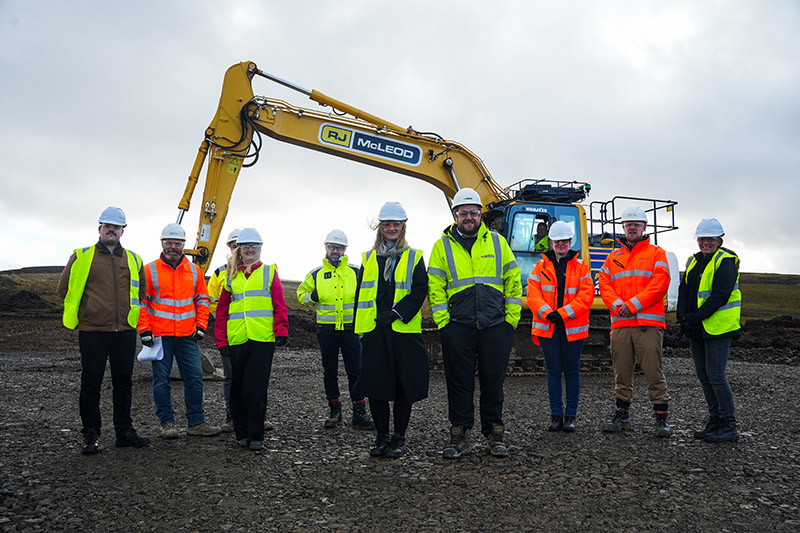
Priestgill Wind Farm is now under construction at Littlegill Farm, 2.2km north east of Abington, South Lanarkshire, following a decade of work to get to this point. Calum Mollison, senior project manager at Muirhall Energy, recently answered Project Scotland’s questions about the milestone initiative.
Q) Can you provide an overview of the project?
A) The 43.6MW, seven turbine scheme represents a significant investment for Muirhall Energy, reaching financial close in September 2025. The current project design was consented by South Lanarkshire Council in March 2021 and was successful in achieving a Contract for Difference from the UK Government in the AR6 auction round.
It’s taken roughly ten years of hard work from the Muirhall team to get to this key milestone and I’m incredibly proud of what we’ve achieved, overcoming many challenges along the way, including grid and planning delays. For construction to have officially kicked off during what is an incredibly challenging time economically for the onshore wind industry more generally, is a real testament to our team. We’re also incredibly grateful for the support from our funding partner, Close Brothers Ltd, who have played such a fundamental role in getting the project to the stage it’s at now.
We look forward to continuing to work closely with our contractors, local stakeholders and our host communities as we work to deliver the project to operation, which is expected later in 2026.
Q) What challenges had to be overcome?
A) The biggest challenge the project faced was planning related delays. This ended up having a knock-on impact for our grid delivery timescales, but as a developer we continue to think outside the box and work with stakeholders, communities and industry partners to find innovative solutions to any challenges faced.
For the grid connection route, which will allow us to deliver our home grown, clean electricity to homes and businesses across the country, we decided to self-deliver an independent grid connection route between the wind farm site and Scottish Power Energy Network’s Elvanfoot Substation which allowed us to significantly accelerate delivery timescales for the project.
This is the first time that we’ve fully delivered a self-build grid route on one of our projects, but we’ve gained some valuable learnings and experience through the process which could potentially benefit other projects in our portfolio, and wider industry.
Q) What do you anticipate some of the more complex construction aspects will be?
A) Wind farm construction by its rural, hilly and remote nature generally involves a lot of complex construction challenges for most sites, primarily due to terrain, ground conditions, topography and availability of suitable weather windows. For Priestgill we are making excellent progress since construction began in September and are working to schedule, but we do have to build in some buffer room for adverse winter weather and plan key activities around milder and safer weather conditions. For example, our plan is to transport turbines to site in spring/summer 2026.
Weather disruption can be a key factor for wind farm construction delays, particularly on elevated sites where high winds may prevent lifting operations, and rain can create unstable ground. The construction of our grid route also involves horizontal directional drilling at certain points, working across steep terrain and at high elevation where weather can have an impact.
In addition, we’ve had to carefully consider how best to utilise and work with our supply chains, which can have long lead times on turbine, electrical components and high voltage cable orders, and finding the most efficient and non-disruptive way of transporting large components to the site, with extensive consideration of how best to reduce community impact. For example, working with turbine delivery specialists we’re currently exploring options to safely self-escort turbine components during busy periods for Policing teams, such as the Glasgow 2026 Commonwealth Games. Which would be another first for Muirhall Energy and the wider industry.
The construction of onshore wind farm projects is incredibly complex and reliant on a range of multi-disciplinary contractors working together, and who are inter-dependent on each other for the success of the project. We’ve got a great team of contractors, who are collaborative and making great progress on the delivery of Priestgill and we look forward to this continuing as we move towards generation later in 2026.
Q) Which companies are involved and why were they chosen?
A) Through a competitive tender process, our lead contractors were chosen due to their due diligence and alignment with Muirhall’s values as a community focused developer that does things efficiently, safely and innovatively. RJ McLeod has been selected as our principal construction contractor for the delivery of the wind farm, with our turbine supply and maintenance agreement being led by Nordex. PowerSystems UK are leading on the delivery of our grid connection route, working with Maxwell Construction and Civils Ltd on the construction aspects.
Through the Priestgill project we, and our principal contractors, are committed to providing contract opportunities to local businesses. A supply chain event was held in November in Abington where over 40 local businesses attended, which was fantastic. It was great to meet so many passionate businesses, make new connections, and explore opportunities to collaborate on the construction of Priestgill Wind Farm. We look forward to continuing these conversations as Priestgill progresses.
Q) What kind of employment opportunities will the project create?
A) At peak construction the site will employ roughly 75 people, including civils operatives, electrical operatives, specialist commissioning resources, turbine installation specialists, management and support staff. Through our local supply chain engagement we are also expected to create opportunities for nearby aggregate and concrete suppliers, fabricators, civils contractors, fencing contractors and plant hire.
Q) What benefits will the wind farm provide once it is operational?
A) Alongside supporting the UK and Scotland’s ambitions for greater energy security and decarbonisation, the project is expected to bring significant local benefits to its host communities, South Lanarkshire and surrounding regions. In addition to local supply chain opportunities the wind farm will deliver £218,000 per annum in community benefit funding to our host communities once operational, creating a positive lasting legacy in the local area.
During construction, we also offer an Initial Investment Fund for local communities in close proximity to our projects, based on a figure of £5,000 per turbine.
Priestgill Wind Farm Initial Investment Fund, worth £35,000, is currently open for applications from community groups, clubs and charities based within the Crawford & Elvanfoot and Duneaton Community Council areas in South Lanarkshire. A good spread of awards have been made to date, examples include a heating upgrade to a local community space, funding towards community events, primary pupil outdoor education trips, upgrades to local school’s outdoor spaces and to the grounds around the local Bowling Green. The benefits will be felt across the community from the youngest to the oldest.
We’ve had a lot of interest in the fund to date and look forward to supporting a number of important community focused projects during construction, and also as the wind farm starts generating.
Q) How have you kept the local community up to date with your plans?
A) The Priestgill project has been developed in close consultation with the local community and statutory consultees, with all feedback received to date helping to directly inform the project’s final design which has evolved over time. This comprehensive approach to local engagement will continue throughout construction and into operation to ensure we keep a two way dialogue going and ensure also that the local community is kept updated on plans and progress.
It’s also very important to us that the way we engage is led directly by community feedback and we’ve taken advice from our host communities directly on how best to share updates as the project moves forward, such as attending local meetings regularly, use of local social media channels, community noticeboards along with regular newsletters to keep community groups and local residents informed. We’re grateful for their meaningful engagement to date and look forward to continuing to work collaboratively and constructively as the Priestgill project moves forward.
For further information on the Priestgill Wind Farm please visit: https://www.muirhallenergy.co.uk/projects/7-priestgill