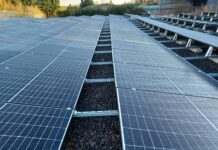

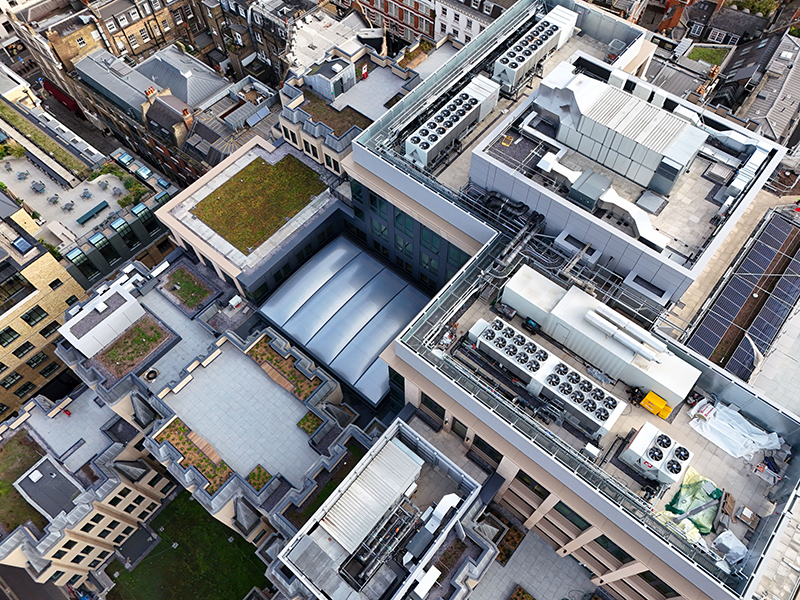
This excerpt from ACO Building Drainage’s recently published Blue Roof Guide Vol 2 details how blue roof integration impacts green, hard-landscaped, and biosolar roofs
MULTIFUNCTIONAL roofscapes across the UK are falling short of their full potential due to poor integration between blue roof attenuation and complementary roof systems. Traditional approaches that store water directly on waterproofing membranes compromise both ecological performance and structural integrity, limiting the effectiveness of green, biosolar and hard-landscaped installations.
Off-membrane storage systems, as used in ACO’s method, offer superior integration that protects waterproofing while enabling controlled irrigation, supporting hard-landscaping, and facilitating biosolar installations.
Understanding blue roof integration principles
Blue roof integration involves designing water storage systems that support multiple roof functions without compromising individual performance requirements. Unlike conventional approaches, integrated systems store water in purpose-designed tanks positioned above the roof build-up.
This separation enables controlled water distribution to planted areas, reduces membrane stress and provides predictable structural loading patterns. The approach allows green, biosolar and hard-landscaped elements to operate as coherent components rather than competing demands on roof space and structural capacity.
Membrane protection and warranty preservation
Off-membrane water storage eliminates the destructive wetting and drying cycles that concentrate moisture at waterproofing joins and penetrations. Surface ponding can create persistent wet zones that accelerate membrane degradation, particularly at perimeter details and penetration points where movement and temperature fluctuations are greatest.
Separated storage systems protect waterproofing integrity by keeping attenuated water out of contact with the more delicate parts of a roof buildup. This reduces failure points at membrane junctions and preserves manufacturer warranties. Typically, to ensure warranties remain intact, water has to be removed from the roof as quickly as possible. Most blue roofing methods do the exact opposite, however ACO’s method keeps water off of the roof at all times. This protection becomes critical in multifunctional installations where membrane replacement would require dismantling entire roofscape systems.
Passive irrigation efficiency
Capillary wicking systems connected to blue roof storage tanks deliver controlled moisture distribution without surface water retention. Wicking mats draw water into growing media and across hard-landscaped areas, providing even irrigation to planted zones whilst keeping water away from sensitive roof details. This passive approach supports vegetation in paved areas, enables biosolar edge planting and maintains planter pockets without requiring mechanical irrigation systems.
The method reduces energy consumption and maintenance requirements whilst ensuring consistent moisture availability during dry periods.
Planning policy compliance support
Early integration of blue roof systems facilitates compliance with policies including the London Plan’s Urban Greening Factor requirements. Considering water storage, wicking distribution and outlet positioning during concept stages enables designers to optimise ecological performance while avoiding late modifications that introduce structural conflicts or access problems.
Design and integration factors
ACO’s system addresses the structural challenges of hard-landscaped inverted roofs by eliminating heavy ballast requirements. The modular tanks are positioned above insulation layers while providing water storage. This approach prevents the risk of insulations floating and reduces installation complexity.
The system integrates with capillary distribution networks to serve planted areas whilst maintaining clear access routes for both irrigation and photovoltaic maintenance. Components comply with relevant building standards and provide simplified installation compared to ballast-dependent alternatives.
Role of professionals
At the early stages of a project, water storage locations must be coordinated with landscape plans and photovoltaic arrays to ensure water for green roof irrigation can reach all intended areas. Construction professionals, including architects and specifiers, should treat blue roofs as system integration exercises rather than standalone features to achieve optimal multifunctional performance.