

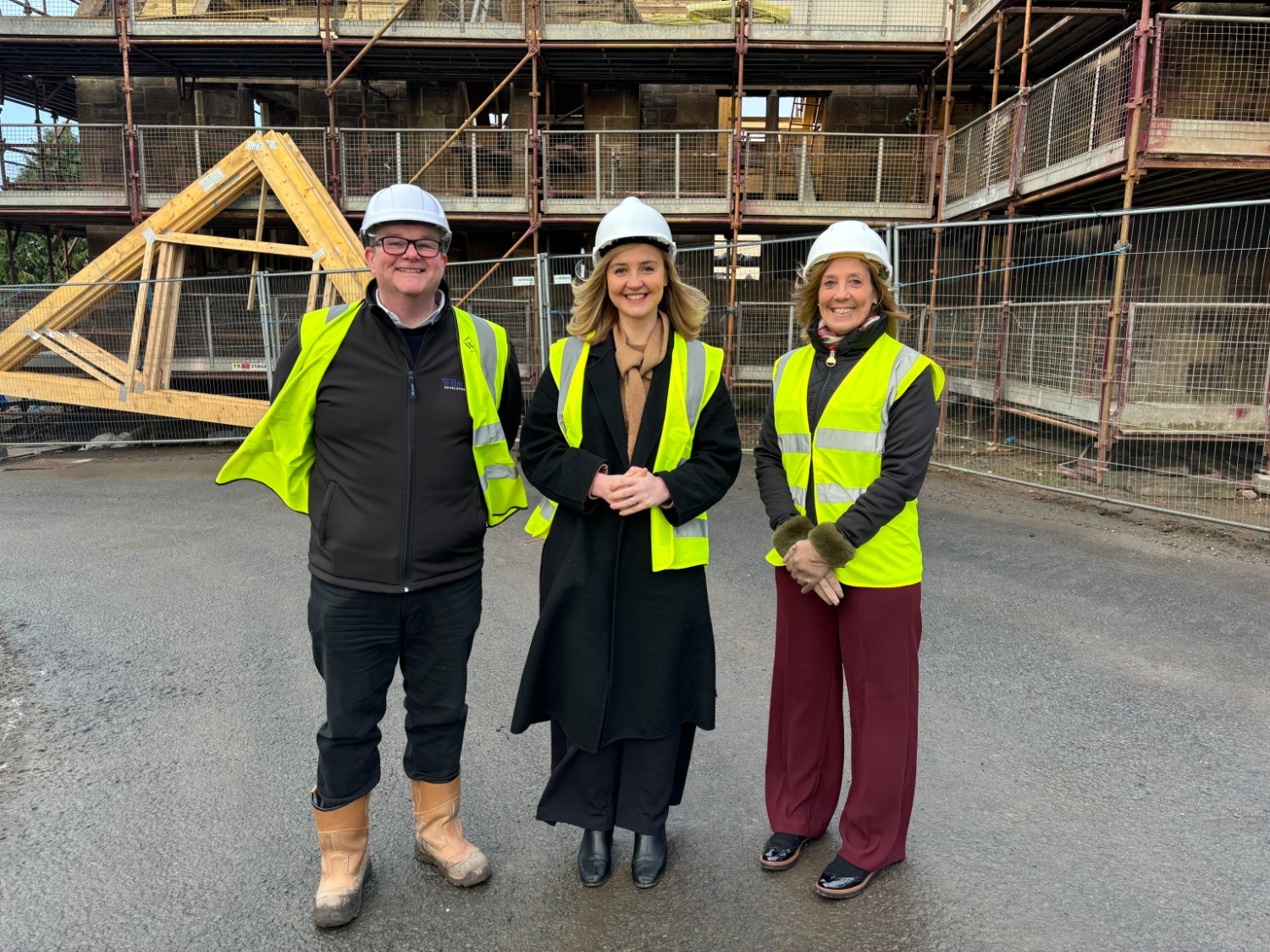
chief executive of Clyde Valley Housing Association
THE final phase of a Lanark housing development, being delivered by Clyde Valley Housing Association in partnership with Wilson Developments, is set to complete in June.
The new build phase of the development – comprising 31 homes, including terraced houses, flats, and cottage flats – was completed and fully occupied in January 2025. The final phase involves the sensitive conversion of the B-listed former Lanark Grammar School annexe into eight apartments.
Cabinet secretary for housing, Màiri McAllan, recently visited the site alongside Scottish Government colleagues and those from South Lanarkshire Council. The visit followed confirmation from the Scottish Government that up to £4.9 billion will be invested over the next four years to support the delivery of 36,000 affordable homes, including a record £4.1 billion of public sector funding.
Màiri McAllan said, “I was incredibly impressed by the work being carried out by Wilson Developments to restore the old Lanark Grammar School building. They have done an amazing job to preserve the old school building, which has been empty for more than 20 years, into homes that families will be able to move into later this year.
“The Scottish Government has provided just over £3million in grant funding for the site and is a demonstration of how working together can not only bring a derelict site back to life but can also deliver safe, warm and affordable homes.”
Carron Garmory, chief executive of Clyde Valley Housing Association, added, “This development is a fantastic example of how sustained investment in affordable housing can transform communities across Scotland. By bringing a long‑vacant historic building back into use and creating high‑quality, energy‑efficient homes for social rent, we are seeing the real difference this work makes to people’s lives.
“Delivering a project of this complexity required careful design and strong partnership working, but seeing families now settled and the final phase nearing completion shows exactly what can be achieved when organisations come together with a shared commitment to quality and community benefit.”
Steven Wilson, MD of Wilson Developments, commented, “The redevelopment of the former Lanark Grammar School demonstrates how the most complex regeneration sites can be unlocked 1through partnership. This project was only made possible through our collaboration with Clyde Valley Housing Association, supported by significant Scottish Government investment.
“Addressing the design, heritage and commercial challenges required difficult decisions, technical expertise and a clear focus on long-term viability. That’s why we’re proud to have worked again with Clyde Valley to deliver 39 much-needed homes for social rent, that protect an important part of Lanark’s built heritage and bring a long-derelict site back into productive use in the town centre.”
The redevelopment combines heritage preservation with the delivery of modern, energy-efficient social housing. Non-original extensions are being removed to support a sympathetic and sustainable conversion, retaining the school’s distinctive multi-gabled character.
Once complete, the final housing mix will include 12 two-bedroom new build flats, 16 two-bedroom new build cottage flats, 3 three-bedroom new build terraced houses, four two-bedroom converted apartments and four three-bedroom converted apartments.
The site at Braxfield Road is already taking shape as a vibrant residential community. Tenants have described the new homes as beautiful, spacious and well finished, and have highlighted the benefits of being close to parks, shops and public transport.
Delivering the scheme required overcoming significant design, technical and heritage constraints. The former school annexe had been vacant for more than 20 years and had fallen into serious disrepair, appearing on both the Buildings at Risk Register and the Dangerous Buildings Register. Previous attempts to redevelop the site had proved economically unviable.