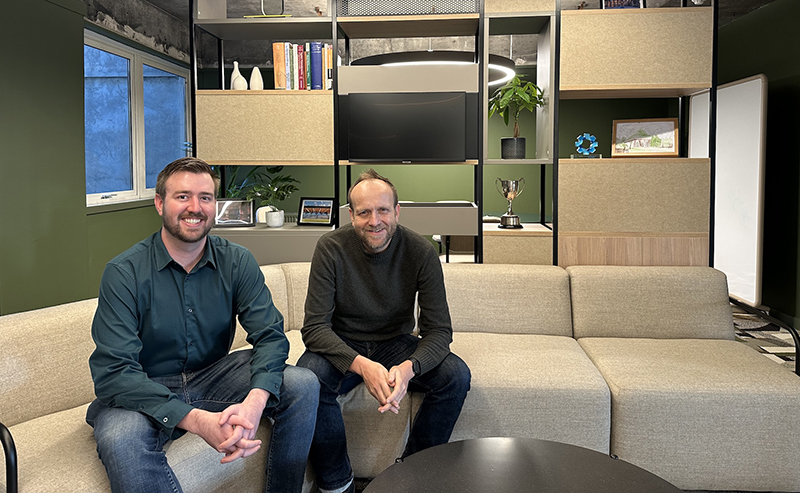
Harley Haddow recently announced the launch of an in-house geotechnical and geoenvironmental capability. The service will be led by senior engineer Conor Fitzsimmons, who has joined the business. He answered Project Scotland’s questions about the offering and how it could potentially evolve over the coming years.
Q) What prompted the decision to launch an in-house geotechnical and geoenvironmental offering?
A) Good site investigations are a crucial part of any development and geotechnical/geoenvironmental engineers are the first to be on site. By having these capabilities in-house, Harley Haddow is able to be involved in projects from the very start and continue to develop its multi-disciplinary approach.
Q) What type of applications and tasks does the service include?
A) Harley Haddow are now able to produce the following reports in-house: Phase 1 Desk Studies, Coal Mining Risk Assessments; Phase 2 Reports on Site Investigations; Phase 3 Remediation Method Statements; and Phase 4 Verification Reports. We are also able to produce interpretive Letter Reports to supplement the above reports.
As the department expands, we will also be able to undertake long-term supervision jobs such as mining remediation works, as well as structural and remedial earthworks.
Q) What are the benefits to clients?
A) Clients can expect the site investigation process to be more efficient than before, as external consultants will no longer need to be brought in to complete the works and interpretive reporting.
Additionally, being able to work closely with the civil and structural engineers will allow us to tailor our investigations to effectively support these services.
Q) What is your background? What kind of projects have you worked on previously?
A) While attending the University of Aberdeen, I studied geology and petroleum geology. Following graduation, I worked with Mason Evans Partnership as a geoenvironmental engineer for around five years before working as a geotechnical project manager for Ardmore Point. Over the course of my career, I have had the opportunity to work on a variety of residential and commercial developments across Scotland and England.
Given the mining and industrial history of much of the central belt, I have been involved in several mineral stabilisation projects as well as environmental remediation works.
In addition to the more traditional approaches to site investigations, I have also been involved in the implementation of other techniques such as geophysical surveys (using the Tromino passive seismometer) to supplement intrusive investigations.
Q) How do you envisage the service evolving over time?
A) In the near future, we will be able to bring more services in-house (i.e. trial pitting, gas/groundwater monitoring, etc.) which will allow us to be more flexible in our approaches to site investigation design and be more competitive in our quotations.
In the long-term, I anticipate we will expand to have multiple geotechnical/geo-environmental teams located in Edinburgh and England, as well as the current team in Glasgow.
Q) What trends are you seeing in the sector currently?
A) I have noted that industry guidance and council expectations are becoming more comprehensive as the understanding of the risks posed by contamination and ground/mine gas improves. As a result, site investigation design and associated interpretive reports need to be far more detailed in order to meet these requirements.
While I know of many that would complain about changing requirements, I consider them an opportunity to improve and produce higher quality work which can only benefit the company and the client in the long run.
Q) Can you help clients meet more ambitious sustainability goals?
A) Yes, a major part of site investigations is to identify any potential risks to the environment resulting from the existing site conditions as well as the proposed development and then recommending remedial measures to help mitigate these risks.
Q) How competitive is the market and how do you intend to stand out?
A) The market is very competitive, the two main aspects of which are costs and timescales. When I design site investigation works I do so in a way that will avoid multiple site visits having to be undertaken, which not only reduces the overall costs to a job but also mitigates the disruption on site. I don’t see any benefit in ‘cutting corners’ by not doing certain works or tests on a site as this will inevitably lead to delays and increased costs to the client down the line.
I intend to stand out through the quality of work that the geotechnical department will produce and completing the works within the timescales agreed upon at the start of the job. Site investigation works will be designed and interpretive reports written to pre-empt council and peer review comments; this will reduce delays to the development resulting from multiple revisions of reports as well as reducing costs resulting from additional site visits.
I also intend to foster a culture of transparency and communication with clients in order to manage expectations as well as demonstrating that targets are being met.