

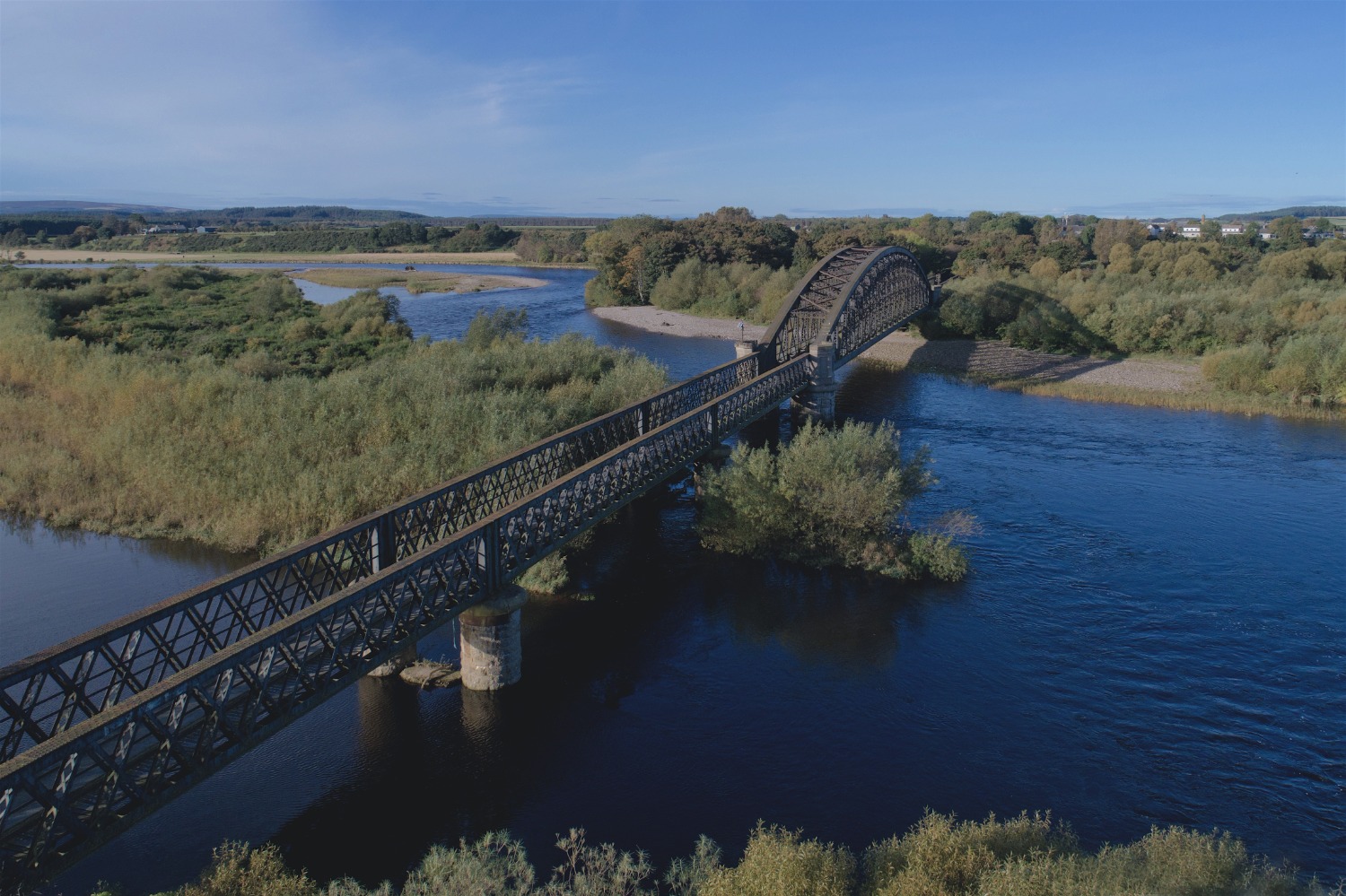
INITIAL inspections of the Garmouth Viaduct have confirmed that its collapse appears to be due to scour, Moray Council engineers have said.
The viaduct, which was built from 1883-86, partially collapsed into the River Spey on Sunday. The local authority said there is no immediate solution to get the bridge in a sufficient state to re-open, with specialist contractors and equipment required to handle the clean-up operation – with the bridge spanning Scotland’s fastest flowing river.
The 950ft-long crossing was originally built to carry a single-track railway, featuring a 350ft-long wrought-iron lattice bow girder span over the main channel and three parallel sided wrought-iron lattice girder approach spans of 100ft at either end.
The lattice members of the main arch, 41ft deep at mid-span, rise from open box girders at each side of the deck. Cast-iron caissons filled with concrete form the piers of the viaduct. These were sunk to bedrock at depths of 25-35ft except for the piers at the west end of the central span where it was necessary to sink them to a depth of 75ft.
A Moray Council spokesperson said that, at the time of the last scour report by a specialist contractor in 2023, there was no evidence of scour. They continued, “It appears that over the last year the river flow path has changed, which may have contributed to a change of impact on the piers. We’re in the process of instructing a specialist engineer to undertake a more detailed inspection and assessment and hope that this can be progressed before Christmas or early in the new year.
“In the immediate future the area around the structure will be made safe with clean-up works to avoid further damage with further detailed inspections necessary, by a specialist contractor, to determine any other works required. The longer-term future of the bridge will be considered in the new year after the initial clear up operation, with options presented to councillors as soon as practicably possible. We’re well aware of the strength of feeling in the local community, and further afield, for this bridge and how well used it is by walkers and cyclists.
“We are installing more robust fencing around the bridge to ensure the safety of the public. The message remains for members of the public to avoid the immediate area, both on land and river users, and not to climb on any part of the bridge for their own safety. While we understand local residents are keen to photograph this historical moment in the life history of the bridge it’s not safe to go under the bridge or climb the structure at this time.”